
Food calories come from three main methods: laboratory or energy-factor calculations; a Nutrition Facts label or composition database; and ingredient-by-ingredient recipe math. For an unlabeled meal, identify each component, match it to the best available value, scale it to the amount eaten and add the results. The total remains an estimate.
- Electronic Code of Federal Regulations — 21 CFR 101.9, Nutrition Labeling of Food
- U.S. Food and Drug Administration — Calories on the Nutrition Facts Label
- USDA FoodData Central — Data Type Documentation
- USDA Agricultural Research Service — Procedures for Estimating Nutrient Values for Food Composition Databases
First, what does a food Calorie measure?
A food Calorie is a unit of energy. The capital-C Calorie used on U.S. food labels is a kilocalorie, which is the amount of energy needed to raise one kilogram of water by one degree Celsius. One kilocalorie equals 1,000 small scientific calories. In everyday nutrition writing, calorie and Calorie usually refer to that same kilocalorie.
A label reports metabolizable energy—the estimated energy your body can use. That is different from the total heat released when food burns in a laboratory. Digestion and absorption differ among food components, so a laboratory heat measurement is not simply copied onto every label.
FDA rules allow several ways to determine calorie content, including food-specific factors, general factors and corrected bomb-calorimetry data. The result is a standardized estimate, not a claim that every person extracts precisely the same energy from every bite.
A label showing 250 Calories is describing about 250 kilocalories of food energy, not 250 tiny laboratory calories.
Related: See the 4-4-9 calorie factors and when they need context
Method 1: laboratory data and energy factors
A bomb calorimeter measures heat released when a dried food sample is combusted. That gives gross energy, but the body does not use food exactly as a combustion chamber does. FDA's permitted bomb-calorimetry method therefore includes a protein correction rather than treating gross heat as the final value.
A more familiar route applies Atwater factors to the food's composition. The general version assigns about 4 calories per gram of protein, 4 per gram of carbohydrate and 9 per gram of fat. More specific Atwater factors vary by food because the usable energy from a gram of a component is not identical in every ingredient. FDA regulations permit both general and specific factors under defined conditions.
Food-composition specialists combine laboratory results, calculations and documented assumptions to build reference values. USDA FoodData Central includes analytically derived Foundation Foods and branded data supplied from product labels. The source and food description matter as much as the number.
Swipe to see the full table
| Approach | What it starts with | What the result represents |
|---|---|---|
| Bomb calorimetry | Heat released by a food sample | Gross energy with required corrections when used for labeling |
| General Atwater factors | Grams of protein, carbohydrate and fat | A practical calorie calculation using standard factors |
| Specific food factors | Composition plus factors for particular foods | A calculation adjusted for differences among ingredients |
| Food-composition analysis | Measured and documented nutrient data | Reference values for a defined food and form |
Method 2: Nutrition Facts labels and food databases
For a packaged product, the current Nutrition Facts label is normally the best starting point. It describes that manufacturer's formulation and states a serving size, servings per container and calories per serving. Your calculation is only correct if you connect those values to the amount you actually consumed. Eating two listed servings means scaling the calories and any tracked nutrients by two.
Do not expect perfect reverse engineering from printed macro grams. Nutrient grams are rounded, while calories are calculated from amounts before rounding. Fiber, sugar alcohols and food-specific factors can also change the result. A 4-4-9 check can spot a major mismatch, but it should not replace the product's label.
For foods without a package, search a composition database using a precise description. Raw boneless chicken breast is not the same record as roasted chicken with skin. Dry rice is not interchangeable with cooked rice. USDA FoodData Central also contains different data types, so check the description, preparation state, portion weight and data source before selecting the first familiar name.
- Use the exact package label when the brand, flavor and formulation are known.
- Use a restaurant's current published nutrition for its standard menu item.
- Use a well-matched USDA entry for basic or unlabeled foods.
- Match raw, cooked, drained or prepared state to the food you measured.
- Scale the value to your portion instead of treating one database serving as a recommendation.
Related: Estimate a meal when there is no Nutrition Facts label
Method 3: recipe and plate calculations
A homemade dish has no single package label, so calculate it from the ingredients. Record each ingredient and amount, find a suitable calorie value, scale that value to the quantity used and add the ingredient totals. Then divide by the actual number of equal portions or by the cooked batch weight. This method works for a pot of soup, a tray of lasagna or a smoothie, provided the ingredient list is complete.
Cooking changes water and sometimes fat content. Water loss raises calories per 100 grams even when no calories were added; water absorption can lower them. Total batch energy changes mainly when something energetic enters or leaves, such as absorbed oil, discarded fat or an added glaze.
For an unknown plated meal, estimate visible parts separately. Rice, chicken, vegetables, dressing and a drink are easier to check as five components than as one generic entry. Note hidden oil and sauces because a camera may miss them.
- List every food, drink, oil, sauce and topping that contributed energy.
- Choose a label, restaurant listing or closely matched database record for each component.
- Convert the reference value to the amount used or eaten.
- Add the component totals for the recipe or plate.
- For a batch, divide by equal servings or the finished cooked weight.
Worked example: calculate a rice bowl component by component
Imagine a bowl with cooked rice, grilled chicken, roasted vegetables and a spoonful of sauce. The numbers below are deliberately rounded examples, not universal values. Your rice variety, meat cut, cooking fat, sauce and portion weights can produce a different result.
Suppose the matched references give 205 calories for the rice portion, 230 for the chicken, 80 for the vegetables including their oil and 70 for the sauce. Add them: 205 + 230 + 80 + 70 = 585 calories. If half the sauce remains in the cup, revise that component instead of keeping the original total. The useful part of the calculation is not only 585; it is the visible trail of assumptions behind it.
Now compare that with choosing one generic chicken rice bowl record. A generic value may be convenient, but it cannot tell whether your bowl had double rice, skin-on chicken or a light sauce. Component math takes longer, yet it lets you correct the part that was wrong without rebuilding the entire meal.
Swipe to see the full table
| Component | Illustrative portion value | Evidence to check |
|---|---|---|
| Cooked rice | 205 calories | Cooked weight and rice type |
| Grilled chicken | 230 calories | Cut, skin and cooked portion |
| Roasted vegetables | 80 calories | Vegetable amount and added oil |
| Sauce | 70 calories | Recipe, label or amount actually used |
| Illustrative total | 585 calories | Revise any component when better evidence appears |
Choose the strongest evidence the meal gives you
There is no single best method for every food. A sealed yogurt cup gives you a label. An apple gives you a database match plus size or weight. A family curry gives you a recipe and cooked yield. A café lunch may give you only a menu description, a photograph and your memory of what was left. Accuracy improves when the method follows the evidence instead of forcing every meal through the same input screen.
Avoid false precision. Database values describe sampled or representative foods, labels use regulatory rounding and portion estimates introduce another layer of uncertainty. Writing 587.36 calories for an unweighed restaurant bowl does not make it more accurate than a sensible rounded estimate. Keep precision proportional to what you actually know.
Consistency still has value. Using the same reasonable food entry, portion cue and oil rule makes repeated meals easier to compare. Update the record when stronger evidence appears, but do not chase precision the information cannot support.
Use BiteLume to turn the method into a repeatable habit
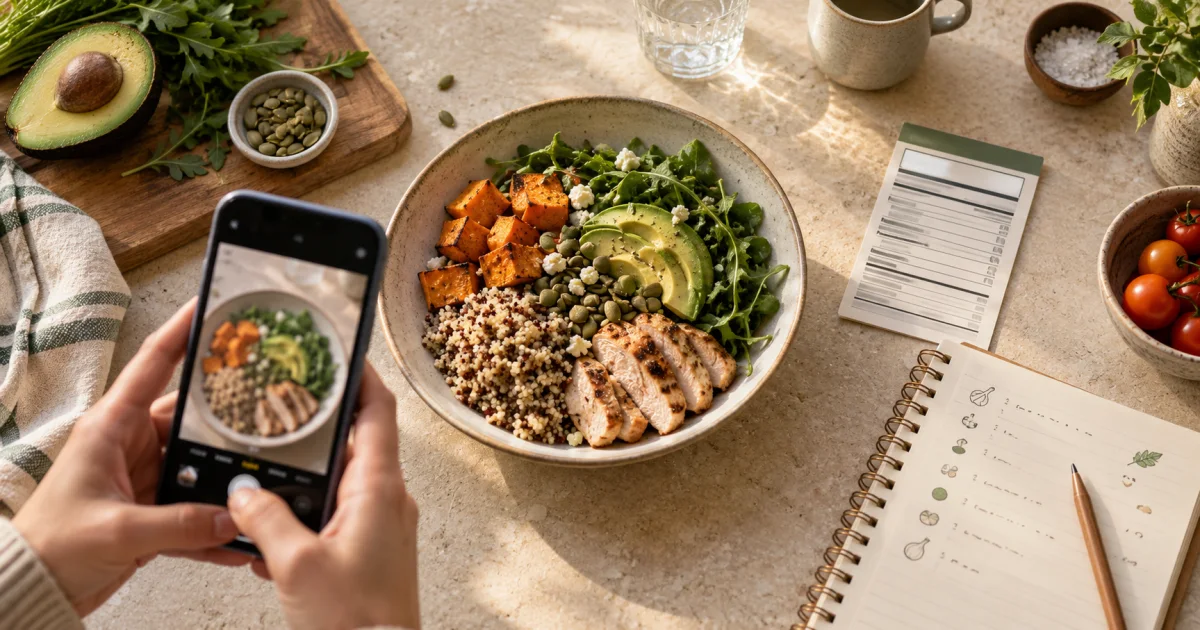
Photograph the complete meal in BiteLume before eating, then review the identified foods, portions, calories and macros. Replace a generic estimate with the exact label when you have one. Add drinks, oils, dressings or second portions that were not visible, and reduce the record for meaningful leftovers.
The image is most useful as evidence: it preserves portion relationships and reminds you what was served. It does not reveal the recipe inside a curry or the oil absorbed by fried food. When those details matter, add what you know and keep the remaining result as an estimate.
Over time, saved meals reduce repeated work. A familiar breakfast can use its known products; a batch recipe can use its calculated portion; an unfamiliar restaurant plate can remain a reviewed photo estimate. That mix reflects how calories are calculated in real life: use the strongest available method, document the portion and stay honest about uncertainty.
Questions people also ask
How do companies calculate calories for a Nutrition Facts label?
FDA rules permit several methods, including specific Atwater factors, general factors for protein, carbohydrate and fat, approved ingredient factors and corrected bomb-calorimetry data. The declared value is reported per serving and follows regulatory rounding rules.
Are food calories measured directly in a laboratory?
Some underlying food-composition data come from laboratory analysis, and bomb calorimetry can measure gross heat. Many practical calorie values are calculated from measured components and food-energy factors rather than by burning every finished product.
How can I calculate calories in food at home?
Match each ingredient or meal component to its exact label or a reliable database entry, scale the reference calories to the amount used, add every component and divide a recipe total by its portions or finished weight.
Why can two calorie estimates for the same meal differ?
They may use different portions, food records, cooking states or assumptions about hidden ingredients. Labels and databases also involve sampling, calculations and rounding. Compare the evidence behind each estimate rather than only the final number.
- See the 4-4-9 calorie factors and when they need context
- Estimate a meal when there is no Nutrition Facts label
- Calculate calories and nutrients for a homemade recipe
- Read serving size and calories in the right order
- Understand how portion size changes a calorie estimate
- Turn a meal photo into a reviewed calorie estimate
Make the next meal easier to track.
Use a photo to get a calorie and macro starting point, review the details, and keep your progress in one place.
Download on theApp Store