
Use this evidence order: an exact recipe, the restaurant's published nutrition, a close USDA FoodData Central match, or a reviewed photo estimate. Break the meal into its main food, starch, vegetables, cooking fat, sauce and drink. Estimate each portion separately, add the values and round sensibly. Record uncertainty instead of pretending an unlabeled meal has an exact calorie count.
- USDA FoodData Central — Data Type Documentation
- USDA FoodData Central — Food Search
- U.S. Food and Drug Administration — How to Understand and Use the Nutrition Facts Label
- U.S. Food and Drug Administration — Menu and Vending Machine Labeling
- USDA Agricultural Research Service — Procedures for Estimating Nutrient Values for Food Composition Databases
Start with an evidence ladder, not a guess
No label does not mean no information. A home cook may know the recipe. A restaurant may publish nutrition online even when the plate arrives without it. A basic food can be matched to USDA FoodData Central. A meal photo can preserve the size and relationship of the remaining parts. Begin with the strongest clue available for each component rather than assigning one confidence level to the whole meal.
Use exact evidence narrowly. A restaurant's standard burger listing does not include shared fries or sauce added at the table. A roasted-chicken record may match the meat but not a buttery glaze. Keep components separate until their portions and sources make sense.
An estimate is successful when it is transparent enough to revise. Notes such as one bowl, restaurant portion, sauce mostly left or about one cup cooked rice are more useful than a suspiciously precise total with no explanation. If better information appears later, you can update the relevant part.
Swipe to see the full table
| Evidence available | Best starting point | Main check |
|---|---|---|
| You cooked the dish | Ingredient amounts and finished yield | Oil, edible amounts and your share |
| Restaurant publishes nutrition | Current listing for the exact item | Size, swaps and customizations |
| Simple unlabeled food | Closely matched USDA food record | Raw or cooked state and portion |
| Mixed meal with unknown recipe | Components plus reviewed photo estimate | Hidden fats, fillings and sauces |
| Shared plate | Total components, then your fraction | What you actually ate rather than what arrived |
Split the meal before you estimate it
Whole-meal names often hide the information you need. Chicken curry might mean a light tomato sauce, a coconut-milk sauce or a cream-based restaurant dish. A sandwich might contain a modest filling or several layers of cheese, dressing and avocado. Identify what you can see and what the menu or cook tells you before searching for a match.
A practical scan is: main protein or filling, starch or bread, vegetables or fruit, cooking fat, sauce or spread, toppings, side and drink. Not every meal has all eight. The point is to notice dense additions that occupy little visual space. A tablespoon of oil can matter more to the estimate than a mound of leafy vegetables, yet it is easier to overlook.
For an ordinary lunch, four or five useful components are often enough. Focus where the estimate can change materially: rice or pasta, meat cut, fried versus grilled preparation, creamy sauce, oil, cheese, nuts and caloric drinks.
- Name the preparation method when you know it: baked, fried, steamed, grilled or raw.
- Separate sauces, dressings and spreads from the food they cover.
- Include beverages, side dishes and small shared plates.
- Note fillings hidden inside wraps, pastries, dumplings or stuffed foods.
- Adjust for food left behind instead of logging the full served plate automatically.
Choose a food record that describes what you ate
USDA FoodData Central includes multiple data types. Foundation Foods offer detailed data for basic foods, FNDDS contains foods and portions used in U.S. dietary surveys, and branded records are based on manufacturer label information. The broadest search result is not necessarily the closest match. Read the full description and portion unit.
Match the state of the food. One hundred grams of dry pasta and one hundred grams of cooked pasta are different because cooked pasta contains absorbed water. The same issue appears with dried beans, cooked rice and meat that loses water during cooking. If your portion estimate is for cooked food, use a cooked record unless you know the dry amount that produced it.
For a regional dish, look for a record that matches the ingredients and preparation, not merely an English translation of the name. When no good composite record exists, use the components you recognize. It is better to log flatbread, grilled meat, vegetables and sauce separately than to select a generic wrap with a very different recipe.
If the record shows one cup and you ate roughly one and a half cups, scale the value. Do not reshape your memory of the meal to fit the default serving.
Use the best portion clue you have
A scale gives a useful weight when it is available, but an estimate can still be made without one. Count uniform pieces, compare the food with a known package size, use a cup or bowl whose capacity you know, or describe the fraction of the original dish. A photograph taken from above and at a slight side angle helps preserve both surface area and depth.
Avoid using your hand as a universal measuring device. Hands differ, and foods do not share the same density. A palm-sized piece of dense cheese and a palm-sized piece of watermelon do not carry similar calorie values. Hand cues can support a repeatable personal estimate, but they do not convert every food into a standard weight.
If a portion lies between plausible values, use a rounded midpoint or note a range. Forgetting a second scoop or choosing dry data for cooked food matters more than deciding whether rice weighed 165 or 180 grams. Fix large uncertainty first.
- Use a known weight or package fraction when one is available.
- Otherwise count pieces or compare the portion with a familiar container.
- Use the photograph to check area, depth and food left after eating.
- Choose a sensible rounded amount and note meaningful uncertainty.
- Apply the same method to repeat meals so comparisons stay useful.
Handle invisible ingredients explicitly
An unlabeled meal's largest uncertainty often sits in ingredients you cannot see. Oil can coat roasted vegetables or remain in a pan. A glossy restaurant sauce may contain sugar, fat or both. Ground-meat dishes can use different fat percentages. Coconut milk, cream, cheese, nut paste and dressing can shift the estimate without changing the plate's apparent size.
Ask a simple question when appropriate: is the sauce cream-, oil- or tomato-based; was the item fried or grilled; is dressing served separately; what size is the drink? You do not need a chef's formula. One useful preparation detail can narrow the choice between two very different database matches.
When the answer is unavailable, make one visible assumption. For example: included one tablespoon of dressing, used a medium restaurant entry or counted one teaspoon of cooking oil in my share. Do not quietly add a large safety buffer to every meal. Consistent documented assumptions are easier to learn from than arbitrary overestimates.
Worked example: an unlabeled café grain bowl
Suppose a bowl contains cooked grain, roasted chickpeas, vegetables, feta and dressing. The café provides no nutrition information. You estimate each part from the visible portion and select closely matched records. In this illustration, the grain contributes 210 calories, chickpeas 170, vegetables and their likely cooking oil 110, feta 80 and the dressing you used 90. The rounded total is 660 calories.
Those numbers are examples, not default values for grain bowls. If the serving contains twice as much dressing, avocado, nuts or a different grain portion, the total changes. If half the grain remains, revise that component. The method works because every number has a job and can be challenged separately.
A reasonable log could say about 660 calories, café portion, dressing mostly used. Writing 659.8 would imply a level of knowledge the meal did not provide. Sensible rounding communicates the quality of the evidence and keeps the estimate useful without dressing it up as a laboratory result.
Swipe to see the full table
| Component | Illustrative estimate | Question that could change it |
|---|---|---|
| Cooked grain | 210 calories | How deep was the scoop? |
| Roasted chickpeas | 170 calories | Were they roasted with oil? |
| Vegetables | 110 calories | How much cooking oil was present? |
| Feta | 80 calories | Was it a light sprinkle or a full scoop? |
| Dressing used | 90 calories | How much remained in the cup? |
| Illustrative total | 660 calories | Revise the component with better evidence |
Make the estimate faster with a BiteLume photo
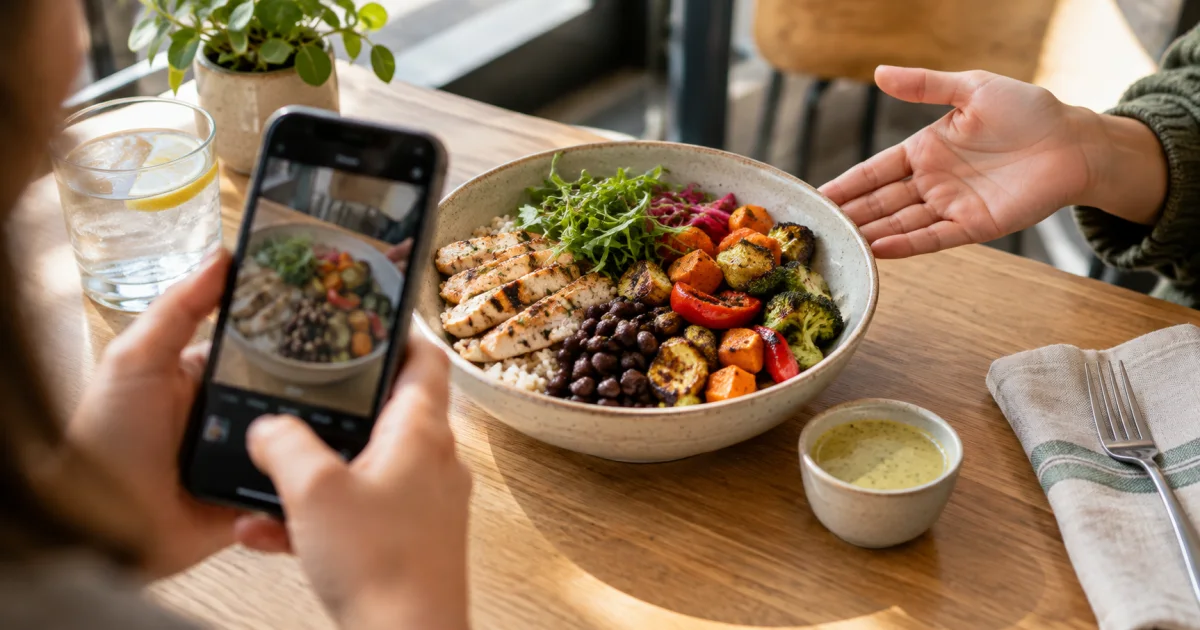
Before eating, place the complete meal and any calorie-containing drink in view and take a clear BiteLume photo. Review the identified foods and portion assumptions. If two ingredients overlap, separate them or add a second angle. For takeout, keeping the container or menu name nearby can provide scale and preparation context.
Correct the result with what you know. Swap in a published restaurant value, add the dressing served off-camera, specify fried rather than grilled, and account for seconds or leftovers. BiteLume can reduce the work of creating a first pass, but it cannot see through bread, identify a manufacturer's recipe or know how much oil remained in the pan.
Save repeat meals with a short note about the evidence. When the same café bowl appears again, you can compare portions instead of starting from nothing. The goal is not to make every unlabeled meal exact. It is to create an honest, reviewable record quickly enough that you will still use it on a busy day.
Questions people also ask
How can I estimate calories if food has no label?
Separate the meal into components, match each one to a reliable database record or known recipe, scale the value to your portion and add the parts. Include oils, sauces, drinks and what you actually ate rather than only what was served.
What is the best calorie database for unlabeled food?
USDA FoodData Central is a strong starting point in the United States. Check the record's data type, full food description, preparation state and portion weight so that the entry actually resembles your food.
Can a photo accurately estimate meal calories?
A photo can preserve portion context and support a useful estimate, but it cannot reliably reveal hidden oil, filling amounts or an unknown recipe. Review the identified foods and replace guesses with labels, recipes or restaurant data when available.
Should I overestimate calories when I am unsure?
Use a reasonable documented assumption or range instead of adding an arbitrary buffer to every meal. A consistent, revisable estimate is more informative than a number made deliberately high without evidence.
Make the next meal easier to track.
Use a photo to get a calorie and macro starting point, review the details, and keep your progress in one place.
Download on theApp Store