For a U.S. Nutrition Facts label, read from the top down. First check serving size and servings per container. Second, decide how many label servings you ate. Third, multiply calories and nutrient grams by that amount. For the whole package, multiply calories per serving by servings per container unless a separate per-container value is already shown. Finally, use % Daily Value as a general comparison tool.
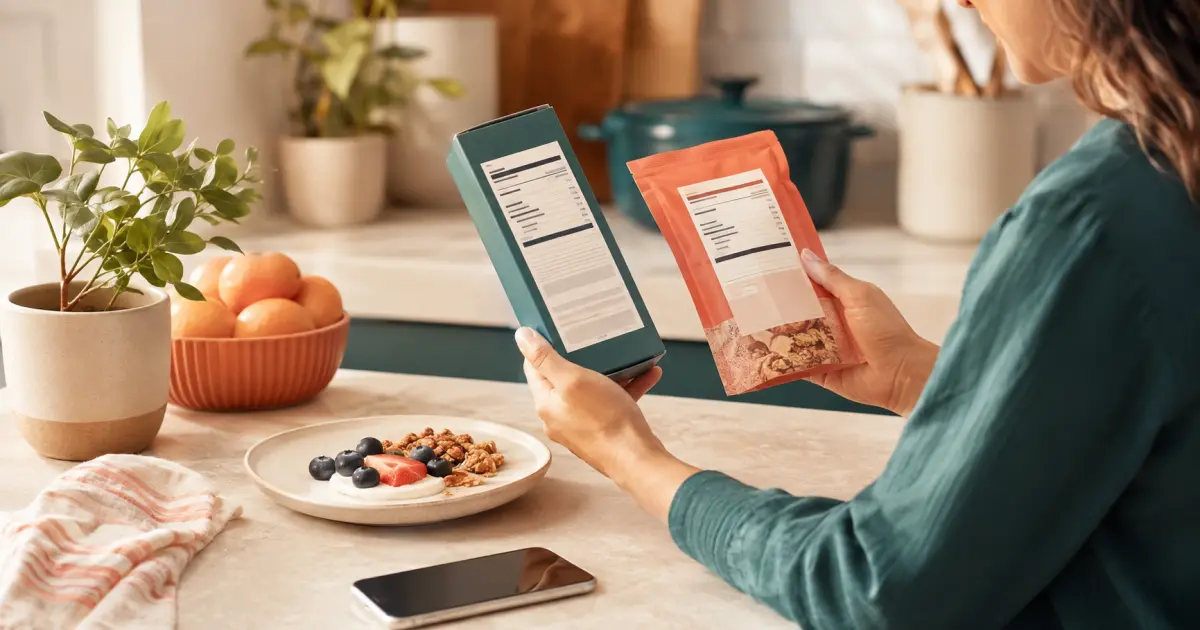
Read a Nutrition Facts label in this order
A Nutrition Facts label contains several kinds of information, but they do not all answer the same question. Serving information defines the reference amount. Calories describe energy in that reference amount. Nutrient grams and milligrams describe its composition, while % Daily Value compares selected nutrients with general daily reference values.
The order matters. Reading 230 calories before noticing that the bag contains four servings can produce a very different log from reading the whole label. Begin at the top, work out the amount consumed, and carry that same multiplier through calories, fat, carbohydrate, protein and any other nutrient you track.
This is the simplest reliable sequence: identify the serving, compare it with your portion, scale the numbers, and then interpret the result. Front-of-package words such as light, high protein or reduced sugar may be useful prompts, but the Nutrition Facts panel and ingredient list provide the details needed to check those impressions.
Swipe to see the full table
| Label area | Question it answers | Common mistake |
|---|---|---|
| Serving information | What amount do these numbers describe? | Assuming the package is one serving |
| Calories | How much energy is in that serving? | Logging the printed number without scaling it |
| Nutrients | How much fat, carbohydrate, protein and other nutrients are present? | Reading grams without checking the serving |
| % Daily Value | How much does one serving contribute to a general daily reference? | Treating it as a personal target |
| Ingredient list | What ingredients are present, in descending order by weight? | Using marketing copy as a substitute |
Start with serving size—not the calorie number
The FDA requires serving size to be based on the amount people typically consume, not the amount an individual should eat. It is a labeling reference, not a recommendation. The household measure—such as one cup, eight pieces or two tablespoons—is normally followed by a metric weight in grams. Both can help you connect the package with your portion.
Next check servings per container. A small bottle, bag or tub can contain more than one. Some products use a dual-column label that shows values both per serving and per package, which removes some arithmetic. When only one column appears, you need to estimate or measure the fraction you consumed.
Suppose a snack lists 160 calories per 30-gram serving and the bag contains three servings. Eating roughly half the bag is about one and a half label servings, so the calorie estimate is 240. The same 1.5 multiplier applies to the listed protein, carbohydrate, fat and sodium. The calculation is transparent even if your portion estimate is not perfect.
Serving size is the label's reference amount. Portion size is the amount you put on your plate or actually consume. Your log should follow the portion.
Calculate calories in the entire container
Use one simple formula when the label shows only per-serving calories: calories per serving × servings per container = calories in the entire container. A package with 150 calories per serving and three servings contains about 450 calories in total. If the package says about 2.5 servings and lists 220 calories per serving, the full-container estimate is about 550 calories.
Do not multiply again when a dual-column label already gives a per-container value. Some bottles, cans and packages are labeled as one serving even when an older or similar product was not, so check the current package instead of relying on memory. The same multiplier applies to fat, carbohydrate, protein, sodium and other listed nutrients.
For part of the package, multiply the full-container total by the fraction you ate, or multiply the per-serving value by the number of servings consumed. If a 450-calorie bag is shared equally by three people, each person's starting estimate is 150 calories. If the shares were unequal, estimate the actual fraction rather than forcing an even split. Words such as about and label rounding mean the result is still an estimate, not laboratory precision.
Swipe to see the full table
| Package information | Calculation | Estimated calories |
|---|---|---|
| 150 calories × 3 servings | 150 × 3 | 450 in the whole container |
| 220 calories × 2.5 servings | 220 × 2.5 | 550 in the whole container |
| 450-calorie container, half eaten | 450 × 0.5 | 225 consumed |
| Per-container column provided | Use the printed container value | No extra multiplication |
Match calories and nutrients to the amount you ate
Once you know the number of label servings, the calculation is consistent: printed value × servings eaten. If one serving has 12 grams of protein and you ate 1.5 servings, record about 18 grams. If you ate half, record about 6 grams. Do the multiplication before comparing the food with a target or another product.
Use the strongest portion clue available. A package fraction is quick when the contents are evenly distributed. Piece counts work for uniform items. The printed gram weight is useful when you have a kitchen scale. A measuring cup or spoon can help with liquids, cereal, sauces and spreads. If none is practical, a clear photo and a familiar container can preserve context for a reasonable estimate.
Account for preparation and additions separately. A label for dry pasta may not describe its cooked weight, and a plain product label does not include the oil, milk, dressing or topping you added. Likewise, drained and undrained values can differ. Match the entry to the state named on the package and add ingredients that are outside that reference.
- Check whether the listed amount is prepared, cooked, dry, drained or as packaged.
- Use the per-container column when the label provides one and you consumed the full container.
- Scale every tracked nutrient by the same serving multiplier.
- Add milk, oil, sauce, toppings or mix-ins that are not included in the printed values.
- Adjust for meaningful leftovers instead of logging everything that was served.
Use % Daily Value as context, not a personal prescription
Percent Daily Value, written as %DV, shows how much one serving contributes to a general daily reference amount. FDA labels use a 2,000-calorie diet for general nutrition advice, but individual energy and nutrient needs vary. A %DV is therefore most useful for comparison and context, not for declaring that everyone needs the same total.
The FDA's general guide describes 5% DV or less per serving as low and 20% DV or more as high. That can help when comparing similar products for nutrients you want to get more or less of. The comparison only works when serving sizes are reasonably aligned. A high value in a tiny serving and a lower value in a much larger serving are not an apples-to-apples test.
Not every line has a %DV. Total sugars, for example, has no established Daily Value on the label, while added sugars does. Protein generally appears in grams without a required %DV for most foods. Read the gram amount when that is the measure connected to your goal, and seek qualified guidance for medical nutrition needs.
Know what the carbohydrate lines include
On a U.S. Nutrition Facts label, total carbohydrate is the umbrella line. Dietary fiber, total sugars and any declared sugar alcohols appear beneath it as components. Do not add those sub-lines to total carbohydrate; they are already represented within it. The separate lines help describe the type of carbohydrate in the serving.
Total sugars includes sugars naturally present in ingredients such as milk or fruit plus any sugars added during processing. The indented line that begins with ‘Includes’ shows how many grams are added sugars. That value is part of total sugars, not an extra amount to add on top. The dedicated guide to added sugar versus total sugar explains the relationship in more detail.
Labels can also be a better anchor than a photo estimate for a specific packaged product. The camera may recognize granola, yogurt or a drink, but it cannot see the manufacturer's formulation. Use the current package when available, then make sure its serving still matches the amount consumed.
Combine the label with a BiteLume meal photo
A label and a meal photo solve different parts of the logging problem. The label describes a known packaged food at a defined serving. The photo shows the plate, sides and portion context from the eating occasion. When both exist, use the label for the product's nutrient values and the image to check how much appeared on the plate and what else was eaten.
In BiteLume, photograph the complete meal before eating and review the foods and portions in the result. Compare any generic estimate with the package information when you know the exact product, and make sure your final record reflects the serving amount, off-camera drinks or condiments, seconds and meaningful leftovers. Photo-derived calories and macros remain estimates; a current label gives you stronger evidence for the labeled item, not a perfect measurement of the whole meal.
For example, a photo may show cereal, berries and milk. The cereal box gives values per 40 grams, the milk carton gives values per cup and the berries may use a USDA reference or photo estimate. Keep those components separate long enough to match their portions, then save the combined breakfast. That produces a record you can explain later instead of one mysterious total.
Swipe to see the full table
| Situation | Best starting evidence | What to review |
|---|---|---|
| Exact packaged product | Current Nutrition Facts label | Serving and amount consumed |
| Restaurant item with published nutrition | Restaurant's current listing | Size and customizations |
| Unlabeled plated meal | Reviewed photo estimate | Foods, portions and hidden additions |
| Known home recipe | Ingredient total and finished yield | Your share of the batch |
| Mixed meal with one packaged item | Label plus photo context | Each component separately |
Use a 30-second label checklist
A useful label routine should be quick enough to repeat. Before saving a packaged food, ask five questions: what is one serving, how many servings are in the container, how much did I consume, are the values for the food in the state I ate it, and what did I add? Those checks prevent more errors than studying every small number on the panel.
Then focus on the nutrients that affect an actual decision. Someone comparing breakfast protein may look at protein grams. Someone reviewing a clinician-recommended sodium limit may use sodium and %DV under professional guidance. Someone building a general calorie log may need only the serving, calories and a few macros. More columns do not automatically make the record more useful.
Labels are standardized tools, but foods and people still vary. Values are declared within labeling rules, portions are estimated, and recipes can change. Keep the package current, record the amount honestly and use repeated patterns rather than treating one label calculation as laboratory precision.
Questions people also ask
What should I look at first on a Nutrition Facts label?
Look first at serving size and servings per container. Every calorie and nutrient value on the panel refers to that serving unless a second per-container column is shown.
Are the calories on a food label for the whole package?
Not always. They are usually listed per serving. For the whole package, multiply calories per serving by servings per container. If a dual-column label already shows calories per container, use that value without multiplying again.
What does % Daily Value mean?
% Daily Value compares the amount of a nutrient in one serving with a general daily reference based on a 2,000-calorie diet. It is a comparison tool, not a personalized target.
Should I use a label or a photo calorie estimate?
Use the current label for the exact packaged product when you have it, and use the meal photo to document your portion and other foods. Match the label serving to what you actually ate.
Make the next meal easier to track.
Use a photo to get a calorie and macro starting point, review the details, and keep your progress in one place.