
Total the calories and nutrients from every ingredient, including oils, sauces and liquids, then weigh the finished edible batch. Divide each total by the finished grams and multiply by 100 for a per-100-gram estimate. For one portion, divide by equal servings or multiply the per-gram value by its weight. This is a home estimate, not a compliant commercial label.
- USDA FoodData Central — Data Type Documentation
- USDA Agricultural Research Service — Procedures for Estimating Nutrient Values for Food Composition Databases
- USDA Agricultural Research Service — Food and Nutrient Database for Dietary Studies Documentation
- U.S. Food and Drug Administration — How to Understand and Use the Nutrition Facts Label
- Electronic Code of Federal Regulations — 21 CFR 101.9, Nutrition Labeling of Food
Know what you are calculating
For personal food tracking, recipe nutrition facts are a documented estimate of the calories and nutrients in your ingredients and portions. They can be detailed and useful without being a legally compliant Nutrition Facts label. Commercial labeling has rules for serving declarations, laboratory or calculation methods, rounding, recordkeeping and exemptions that a kitchen spreadsheet does not satisfy.
Decide what result you need. For meal prep, calories and protein per container may be enough. For a shared pot, a per-100-gram value handles unequal servings. Clinician-directed limits may require sodium, carbohydrate or another nutrient from exact labels and suitable database records.
Keep the method proportional to the decision. Weighing a casserole matters because water loss changes its per-gram value. Trace spices may matter less. Do not omit ingredients for convenience, but focus care where the result can change materially.
A personal recipe calculation is not a substitute for regulatory labeling work. If the recipe is for sale, consult the rules and qualified labeling support that apply to the product and market.
Build an ingredient inventory you can audit
Write down ingredients while cooking rather than reconstructing the recipe later. Record the amount actually entering the pan: the oil poured, the drained weight of beans, the milk added to a sauce and the portion of a package used. Include toppings or garnishes only if they are part of the batch; optional toppings are clearer as separate additions to each serving.
Use edible amounts. Banana peel, chicken bones, a drained can's packing liquid and vegetable trimmings should not be counted as food consumed unless the selected data record already handles that form. When an ingredient is weighed in a non-edible state, either measure the edible portion or apply a documented yield appropriate to it.
Keep brands when they matter. Two pasta sauces can differ in calories, carbohydrate and sodium. Prefer the product's current label to a generic match. For basic foods, choose a USDA record matching the raw or cooked state used.
Swipe to see the full table
| Ingredient detail | Record this | Common source of error |
|---|---|---|
| Packaged product | Brand, product, grams used and label serving | Using a generic item with a different formulation |
| Basic food | Precise food description and edible grams | Mixing raw and cooked records |
| Cooking oil | Amount added and any known amount discarded | Forgetting oil that remains in the food |
| Canned ingredient | Drained or undrained amount to match the record | Using total can weight for drained food |
| Optional topping | Amount on each serving | Adding it to the batch and again to the bowl |
Scale every ingredient to the amount used
Convert each ingredient's reference data to your recipe amount. If a label lists 160 calories and 8 grams of fat per 40 grams, and the recipe uses 60 grams, the multiplier is 60 ÷ 40 = 1.5. That ingredient contributes 240 calories and 12 grams of fat. Use the same multiplier for protein, carbohydrate, sodium and every other nutrient you track.
For data listed per 100 grams, divide the ingredient weight by 100 and multiply by each nutrient value. A 175-gram amount uses a multiplier of 1.75. Do not interchange grams and milliliters without a reliable density conversion.
Add each ingredient's contribution to create whole-recipe totals. Do not calculate calories from rounded macro grams and then discard the source calories. Food records may use more specific energy factors, and fiber or sugar alcohols can complicate basic 4-4-9 math. Store source calories and nutrients separately, then use macro arithmetic as a reasonableness check.
- Record the edible amount used for every ingredient.
- Choose an exact label or a closely matched database record.
- Calculate amount used ÷ reference amount to get the multiplier.
- Multiply each calorie and nutrient value by that multiplier.
- Add the ingredient contributions for whole-recipe totals.
- Save the sources and assumptions with the recipe.
Weigh the finished batch after cooking
The ingredient total tells you what entered the recipe. The finished yield tells you how that total is distributed. Weigh the empty cooled pot or storage container, weigh it again with the finished food, and subtract the container. Use the edible cooked weight after bones, cooking liquid that was discarded or other refuse have been removed.
This step captures water change. A soup may gain water; roasted food may lose it. If a 3,000-gram raw mixture becomes a 2,400-gram finished dish, the total recipe calories have not risen merely because each 100 grams now contains a larger share of the batch. Conversely, adding water increases weight without adding calories and lowers calories per 100 grams.
Cooking can change more than water. Fat may be poured away, oil absorbed or food left in the pan. USDA recipe systems use yield and retention methods for weight and nutrient changes. At home, record observable inputs and edible yield, then acknowledge what remains uncertain.
- Tare or subtract the empty container.
- Use the finished edible weight, not the uncooked ingredient total.
- Record cooking oil and fat intentionally removed or added.
- Reweigh if you later add broth, sauce or toppings to the batch.
- Keep one yield method for repeat recipes so versions remain comparable.
Calculate per 100 grams or per serving
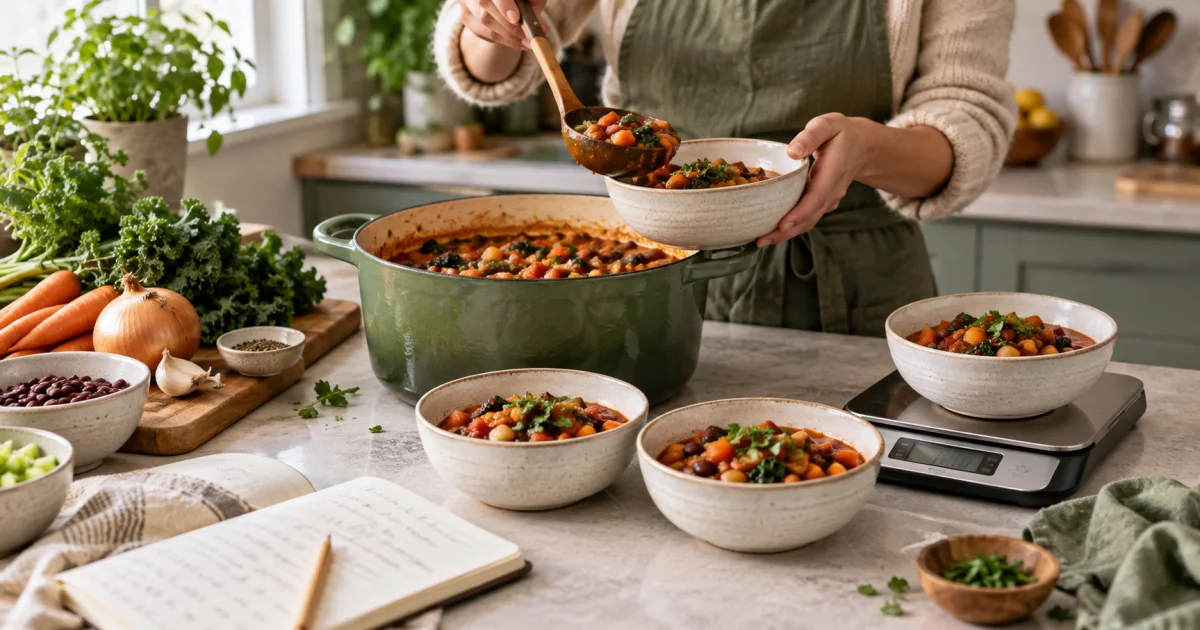
Suppose a finished pot weighs 2,300 grams and the ingredient total is 2,760 calories. Divide 2,760 by 2,300 to get 1.2 calories per gram. Multiply by 100 for 120 calories per 100 grams. A 375-gram bowl is 375 × 1.2 = 450 calories. If the pot is divided into six equal shares instead, each share is 2,760 ÷ 6 = 460 calories.
Use the same formula for nutrients. If the full recipe contains 138 grams of protein, each gram of finished food contains 138 ÷ 2,300 = 0.06 grams protein. That is 6 grams per 100 grams, 22.5 grams in a 375-gram bowl or 23 grams in one-sixth of the pot before sensible rounding.
Label the denominator clearly. Per 100 grams is not per serving, and a serving is useful only when defined. If bowls vary from 250 to 500 grams, record each weight or state that the batch was divided equally.
Swipe to see the full table
| Result wanted | Formula | Worked result |
|---|---|---|
| Calories per gram | 2,760 ÷ 2,300 g | 1.2 calories/g |
| Calories per 100 g | 1.2 × 100 | 120 calories |
| Calories in a 375 g bowl | 1.2 × 375 | 450 calories |
| Calories in 1 of 6 equal portions | 2,760 ÷ 6 | 460 calories |
| Protein in a 375 g bowl | 138 ÷ 2,300 × 375 | 22.5 g before rounding |
Quality-check the result before saving it
Start with omissions. Cooking oil, stock concentrate, coconut milk, cheese, sugar, sauce and tasting portions are easy to miss. Next check unit mistakes: entering ounces as grams, using a 100-gram value as a per-serving value, or applying a whole-package label to half a package can distort every portion.
Check raw and cooked states. If you weighed dry rice, use dry rice data and let the finished recipe weight account for absorbed water. If you weighed cooked rice before adding it, use a cooked record. Either approach can work, but switching states in the middle double-counts or loses the water change.
Compare the result with the ingredients. A cream- and oil-rich sauce should not calculate as nearly fat-free, and one of twelve portions should not show the whole-batch calories. This check catches transcription errors before saving.
Swipe to see the full table
| Unexpected result | Check first | Likely fix |
|---|---|---|
| Calories far too high | Unit and package multipliers | Correct grams, ounces or servings used |
| Calories far too low | Oil, sauces and omitted ingredients | Add the missing contribution |
| Per-100-g value changed after cooking | Finished water gain or loss | Confirm cooked yield rather than forcing the old value |
| Every bowl has the same number despite different sizes | Serving method | Use the per-gram value for each bowl weight |
| Macro calories differ slightly | Rounding, fiber and food factors | Keep source data and investigate only material gaps |
Save the recipe once, then track the portion in BiteLume
Keep a recipe record with ingredient amounts, data sources, finished weight and calculation date. When a product or quantity changes, duplicate the recipe as a new version rather than silently overwriting the old one. A lighter coconut milk, a different meat percentage or an extra spoonful of oil can make the saved result less representative.
Photograph the served portion in BiteLume and use the image to preserve the meal context. When you know the portion weight, use the calculated per-gram recipe value. Add toppings, bread, drinks or sides separately if they were not included in the batch calculation. Review leftovers when the served amount and eaten amount differ.
For nights when the recipe was improvised, the photo can supply a practical starting estimate. Add known ingredients and state the uncertainty rather than pretending the dish matches the saved version. The best workflow is flexible: careful batch math for repeat recipes, a reviewed photo estimate for one-off meals and clear notes whenever evidence is incomplete.
Questions people also ask
How do I calculate calories per serving in a homemade recipe?
Add calories from every ingredient, then divide the recipe total by the number of equal servings. If servings are unequal, divide by the finished batch weight to get calories per gram and multiply by each portion's weight.
How do I calculate nutrition per 100 grams?
Weigh the finished edible recipe. Divide each whole-recipe calorie or nutrient total by the finished grams, then multiply by 100. Use cooked yield because water loss or gain changes the per-100-gram concentration.
Should I use raw or cooked ingredient weights in a recipe calculator?
Use the state that matches your measurement and food record. If you weigh dry pasta, use dry data; if you add already cooked pasta by weight, use cooked data. Then use the finished batch weight for portion calculations.
Can I create a legal Nutrition Facts label from a home recipe calculation?
A personal recipe estimate is not automatically a compliant commercial label. Products sold to consumers may be subject to specific calculation, serving, rounding, testing, recordkeeping and format rules. Obtain qualified regulatory support for commercial use.
Make the next meal easier to track.
Use a photo to get a calorie and macro starting point, review the details, and keep your progress in one place.
Download on theApp Store