
Use 4 calories per gram of protein, 4 per gram of carbohydrate, 9 per gram of fat and 7 per gram of alcohol. Multiply each amount by its factor, then add the results. For example, 30 grams of protein, 45 grams of carbohydrate and 20 grams of fat give about 480 calories. Use this as a cross-check; labels can differ.
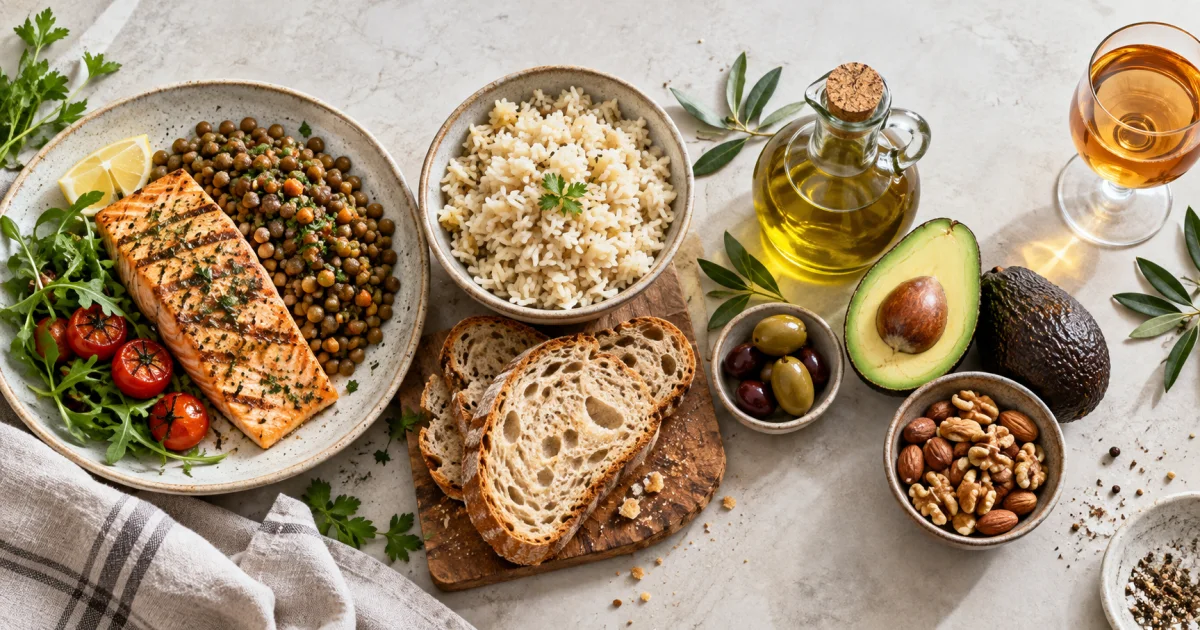
The calories-per-gram table
The 4-4-9 rule is shorthand for general Atwater factors. It estimates metabolizable energy, meaning the portion of food energy considered available to the body rather than all heat released in a combustion test. U.S. labeling regulations allow general factors of 4, 4 and 9 for protein, total carbohydrate and total fat, alongside other permitted calculation methods.
Alcohol is not one of the three macronutrients shown as a standard gram line on the Nutrition Facts panel, but ethanol supplies about 7 calories per gram. An alcoholic drink may also contain carbohydrate, fat or protein from sugar, cream, juice or other ingredients. Those calories sit alongside the energy from alcohol itself.
A gram is a unit of mass, not a serving. One gram of fat supplies more energy than one gram of protein or carbohydrate, but foods are mixtures of water, fiber, minerals and many other components. A 100-gram serving of avocado is not 900 calories because only part of that serving is fat. Apply the factors to grams of the components, not to the food's entire weight.
Swipe to see the full table
| Energy source | General calories per gram | Quick calculation |
|---|---|---|
| Protein | 4 | Protein grams × 4 |
| Carbohydrate | 4 | Carbohydrate grams × 4 |
| Fat | 9 | Fat grams × 9 |
| Alcohol (ethanol) | 7 | Alcohol grams × 7 |
Protein: 4. Carbohydrate: 4. Fat: 9. Alcohol: 7. Fiber and sugar alcohols need separate context, so do not force them into the basic shortcut.
Related: See the three methods used to calculate food calories
How to calculate calories from macros
Take the grams of protein, total carbohydrate and fat for the same portion. Multiply protein by 4, carbohydrate by 4 and fat by 9. Add alcohol multiplied by 7 when the grams of ethanol are known. Keep all values tied to one serving size; combining per-serving protein with per-container fat creates a plausible-looking but meaningless total.
For a meal with 30 grams of protein, 45 grams of carbohydrate and 20 grams of fat, the calculation is 30 × 4 = 120, 45 × 4 = 180 and 20 × 9 = 180. Add those subtotals to get about 480 calories. That is a useful sense check for a meal estimate.
If a package contains two servings and you eat both, double the macro grams before applying the factors, or calculate one serving and double the result. Use the same route for every component. The order does not change the arithmetic, but stating the portion first prevents the most common mistake.
- Confirm that every gram value refers to the same portion.
- Multiply protein grams by 4.
- Multiply total carbohydrate grams by 4.
- Multiply fat grams by 9.
- If known and relevant, multiply alcohol grams by 7.
- Add the subtotals and round the result sensibly.
Swipe to see the full table
| Component in example | Math | Estimated calories |
|---|---|---|
| 30 g protein | 30 × 4 | 120 |
| 45 g carbohydrate | 45 × 4 | 180 |
| 20 g fat | 20 × 9 | 180 |
| Total | 120 + 180 + 180 | 480 |
Why your macro math may not match the label
A small difference does not automatically mean the label is wrong. FDA rules say calorie factors are applied to the actual component amounts before those amounts are rounded for display. Meanwhile, total calories have their own rounding increments. You may be multiplying three already rounded gram values and comparing the result with a separately rounded calorie value.
Consider a simplified product containing actual amounts of 4.4 grams protein, 9.4 grams carbohydrate and 2.4 grams fat. Those might display as 4, 9 and 2 grams. Basic math on the displayed values gives 70 calories. Math on the unrounded values gives about 77 calories before the calorie declaration is rounded. The package can therefore show a higher number even though both lines follow their respective rules.
General 4-4-9 factors are not the only permitted method. FDA rules also allow specific Atwater factors for particular foods, approved ingredient factors and corrected bomb-calorimetry data. Alcohol, non-digestible carbohydrate and sugar alcohols introduce further differences. Use a large mismatch as a prompt to recheck servings and transcription, not as proof of misconduct.
- Nutrient grams and calories are rounded separately.
- Calculations use actual component amounts before label rounding.
- Specific food factors may differ from the general shortcut.
- Fiber and sugar alcohols do not always contribute 4 calories per gram.
- Alcohol supplies energy but is not included in protein, fat or total carbohydrate grams.
Fiber and sugar alcohols are the important exceptions
Total carbohydrate on a U.S. label includes dietary fiber, while the energy available from non-digestible carbohydrate is not necessarily 4 calories per gram. Under one FDA-permitted calculation approach, soluble non-digestible carbohydrate uses a general factor of 2 calories per gram and non-digestible carbohydrate is excluded from the 4-calorie carbohydrate amount. That is already more nuanced than total carbs multiplied by four.
Sugar alcohols also vary. The federal regulation lists different general factors for specific substances, including erythritol, xylitol, sorbitol and maltitol. Treating all sugar alcohol grams as either zero or four can therefore move the result in the wrong direction. The ingredient used matters.
This is why subtracting every gram of fiber or sugar alcohol to calculate net carbs and then applying 4-4-9 is not a reliable way to reconstruct all food labels. For calorie logging, use the current declared calories for the exact packaged product. Use the macro shortcut to understand scale, check serving errors or estimate a simple combination whose components are known.
Swipe to see the full table
| Situation | Better choice | Why |
|---|---|---|
| Exact packaged food | Use declared calories for your portion | Manufacturer has formulation data and applies labeling rules |
| Simple meal with known macros | Use 4-4-9 as an estimate | The shortcut gives a transparent cross-check |
| High-fiber product | Expect possible difference | Not all carbohydrate contributes the general 4 calories per gram |
| Product with sugar alcohols | Use label or ingredient-specific factor | Energy factors vary by sugar alcohol |
| Alcoholic drink | Use published drink data when available | Alcohol and other ingredients both contribute energy |
Use the formula as a check, not a nutrition verdict
Calories per gram describe energy, not the full nutritional value of a food. Protein, carbohydrate and fat categories contain foods with very different vitamins, minerals, fiber, flavors, costs and cultural roles. Two meals can share a calorie total while differing in composition and how they fit a person's needs.
The factors also do not prescribe a macro split. Choosing how much protein, carbohydrate or fat to eat depends on the person, overall dietary pattern, activity, preferences and any clinical needs. A formula that converts grams to calories cannot decide those questions. People managing a health condition or pursuing a specialized sports goal should use qualified individualized guidance.
Where the formula shines is quality control. If an entry says 40 grams fat but only 150 calories, something is probably wrong with the serving or data. If two servings were eaten but only one serving's macros were entered, the mismatch exposes it. Use 4-4-9 to find errors that matter, then return to the label or original food record for the final entry.
Check calories and macros together in BiteLume
Photograph the full meal in BiteLume and review the estimated foods, portions, calories and macro grams. If an exact package is part of the meal, replace the generic values with its current label. Make sure the serving amount is the same across calories, protein, carbohydrate and fat before judging whether the numbers agree.
For a homemade dish, calculate the whole recipe from its ingredients and finished yield. For a restaurant plate, treat the photo estimate as a starting point and add sauces, oil, drinks or fillings the image cannot identify. The 4-4-9 check can flag an obvious data-entry error, but it cannot recover a hidden recipe.
Keep the final precision realistic. A meal estimated from a photograph does not become laboratory-accurate because its macros produce a total to one decimal place. Save a rounded reviewed estimate, note important assumptions and use the same method when you want to compare the meal again.
Questions people also ask
How many calories are in one gram of protein?
The general Atwater factor is about 4 calories per gram of protein. Food labels may use actual unrounded amounts and permitted food-specific methods, so multiplying the displayed protein alone will not reconstruct the full calorie value.
How many calories are in one gram of carbs and fat?
General factors assign about 4 calories per gram of carbohydrate and 9 per gram of fat. Fiber and sugar alcohols require more context because their energy factors can differ from ordinary digestible carbohydrate.
How many calories are in one gram of alcohol?
Alcohol, meaning ethanol, provides about 7 calories per gram. Alcoholic beverages may also contain calories from carbohydrate, fat or protein in ingredients such as sugar, juice or cream.
Why does 4-4-9 math not equal the calories on my label?
You are multiplying rounded nutrient grams, while the manufacturer calculates with actual amounts before rounding. Specific Atwater factors, fiber, sugar alcohols, alcohol and separate calorie-rounding rules can also create a legitimate difference.
Make the next meal easier to track.
Use a photo to get a calorie and macro starting point, review the details, and keep your progress in one place.
Download on theApp Store