Calorie apps disagree when they use different serving sizes, food entries, recipes, cooking states or visual portion estimates. Compare the stated grams and ingredients first. Prefer an exact package label or restaurant listing when available, then a closely matched food-database record. For an unlabeled meal, use a reviewed estimate and keep the same method over time.
- U.S. Food and Drug Administration — Calories on the Nutrition Facts Label
- Electronic Code of Federal Regulations — 21 CFR 101.9, Nutrition Labeling of Food
- USDA FoodData Central — Data Type Documentation
- Journal of the Academy of Nutrition and Dietetics — Image-assisted dietary assessment systematic review
Five reasons the same food gets different calorie totals
Start with serving size. One app may show a medium banana, another 100 grams and a third the weight you entered. All three records can be reasonable while producing different totals. The number means little until you know what quantity it describes.
Next, check the food itself. A generic chicken sandwich, a specific chain's sandwich and a homemade sandwich are not interchangeable. Bread thickness, meat, cheese, sauce and cooking oil can change the result even when the meal has the same everyday name. Preparation matters too: a raw ingredient record and a cooked record often have different values per 100 grams because cooking changes water and sometimes fat.
Finally, apps do not all draw from the same source or apply the same matching logic. One may prioritize a manufacturer label, another a community-created entry and another a composition database. An AI photo tool must also identify the foods and infer their portions. These differences accumulate before rounding is even considered.
Swipe to see the full table
| Source of disagreement | What to compare | Typical correction |
|---|---|---|
| Serving size | Grams, pieces or container fraction | Convert both estimates to the amount eaten |
| Food identity | Brand, recipe and ingredients | Choose the entry that matches the actual food |
| Preparation state | Raw, cooked, drained or fried | Match the state that was measured |
| Database source | Label, official database or user entry | Prefer the strongest traceable source |
| Photo interpretation | Detected foods and visible portions | Compare missed items and portion assumptions |
Compare like with like before judging accuracy
Put both app results into the same unit. If one says 210 calories per serving and the other says 145 calories per 100 grams, find the serving's gram weight before comparing them. A 145-calorie-per-100-gram food would be about 218 calories at 150 grams, which may make the supposed disagreement disappear.
Check whether the value describes the whole item or one serving. A bottle, bag or frozen meal can contain more than one labeled serving. Restaurant listings may cover the standard item without optional sauce or a side. Recipe entries may be based on eight portions even though the cook divided the dish into six.
Keep nutrients tied to the same portion. Comparing one app's calories for the entire package with another app's protein for a single serving creates a convincing but false mismatch. Write the quantity beside every number while you investigate.
- Open the serving details in both apps.
- Convert the records to the same grams, milliliters or item count.
- Confirm brand, flavor and preparation state.
- Check whether sauces, toppings and sides are included.
- Compare the original source and its update date when shown.
- Save the closest match with a realistic level of precision.
The same food name can hide a different recipe
Food names are broad categories, not laboratory specifications. A bowl of chili may contain lean beef, higher-fat beef, beans, cheese, sour cream or different amounts of oil. Even two plain croissants can differ in size and butter content. If the ingredients or portion are different, there is no single correct calorie number shared by every version.
Branded products can change as manufacturers reformulate them. A database entry copied from an older package may no longer match the label in your hand. When the exact product is available, use its current Nutrition Facts panel and scale it to what you ate. FDA labeling rules permit defined calculation and rounding methods, so printed calories may not exactly equal a calculation made from the displayed, already-rounded macro grams.
For basic foods, select a record whose description matches closely. Cooked skinless chicken breast is a better match for a cooked skinless portion than a generic entry that does not state the cut or preparation. USDA FoodData Central includes multiple data types and food descriptions; the first search result is not automatically the best one.
Before asking which calorie total is right, ask whether both apps describe the same product, preparation and amount. Often they do not.
Related: Understand the accuracy limits of AI calorie counters
Why photo calorie scanners can disagree even more
A meal photo preserves useful evidence, but it does not reveal everything. A scanner has to infer the food identity, plate scale and depth of each portion. It cannot see oil absorbed during cooking, sugar in a marinade, ingredients blended into a sauce or food hidden beneath another item. Different models can make different reasonable guesses from the same pixels.
Camera angle and framing matter. A shallow bowl photographed from above can make depth hard to judge; a close crop can remove the plate or utensils that provide scale. Mixed dishes are harder than separated foods because their components are concealed. One scanner may call a dish chicken curry while another treats it as chicken, sauce and rice, leading to different assumptions.
Treat an image result as a starting estimate. Review the identified foods, note anything plainly mismatched, account for drinks and off-camera items, and compare the portion with what you know. A confident interface does not remove uncertainty from the meal.
- Photograph the whole plate in even light.
- Keep a familiar object or the plate edge visible for scale.
- Separate foods visually when practical.
- Account separately for oil, dressing, beverages and second servings.
- Use a label, recipe or weight when it provides stronger evidence than the image.
Which calorie number should you trust?
Use a simple evidence hierarchy. For a packaged food, the current label for that exact product is usually the strongest practical source. For a standard restaurant item, use the restaurant's current published nutrition. For a basic food, choose a well-matched record from an authoritative composition database. For a homemade recipe, total its ingredients and divide by the finished yield. For an unknown meal, use a reviewed estimate.
Trust is not the same as certainty. Package values follow permitted tolerances and rounding; database foods vary naturally; restaurant portions are not identical; recipes change; visual estimates depend on what is visible. The aim is the best-supported number for the decision you are making, not a fictional exact count.
If the difference is small compared with the meal's uncertainty, choose one defensible estimate and move on. If the difference is large, investigate serving size, oil, sauce and entry quality first. Those checks usually explain more than switching repeatedly between apps.
Swipe to see the full table
| Food situation | Best practical starting point | Main limitation |
|---|---|---|
| Exact packaged product | Current package label | Rounding and formulation changes |
| Standard chain meal | Restaurant's current nutrition | Customization and portion variation |
| Basic ingredient | Closely matched authoritative database record | Natural variation and preparation state |
| Homemade recipe | Ingredient totals plus finished yield | Missing ingredients and cooking losses |
| Unknown plated meal | Reviewed photo or component estimate | Hidden ingredients and portion inference |
Build consistency without pretending the estimate is exact
Consistency makes trends easier to interpret. Save a reliable entry for foods you repeat, use the same recipe version until the ingredients change and follow one portion method. That reduces random variation caused by choosing a different database item every time.
Consistency should not preserve a known mistake. Use the current package value when a label changes, and account for it when you discover that a serving was double the amount first assumed. Keep notes for meaningful assumptions, such as whether a recipe included the cooking oil.
Avoid using extra decimal places to make uncertain inputs look precise. A restaurant plate estimated from appearance is better recorded as a sensible rounded value than 673.42 calories. Precision should reflect the evidence. For medical nutrition needs or an eating pattern prescribed for a health condition, work with a registered dietitian or clinician rather than relying on consumer app estimates alone.
Use BiteLume to keep the evidence with the estimate
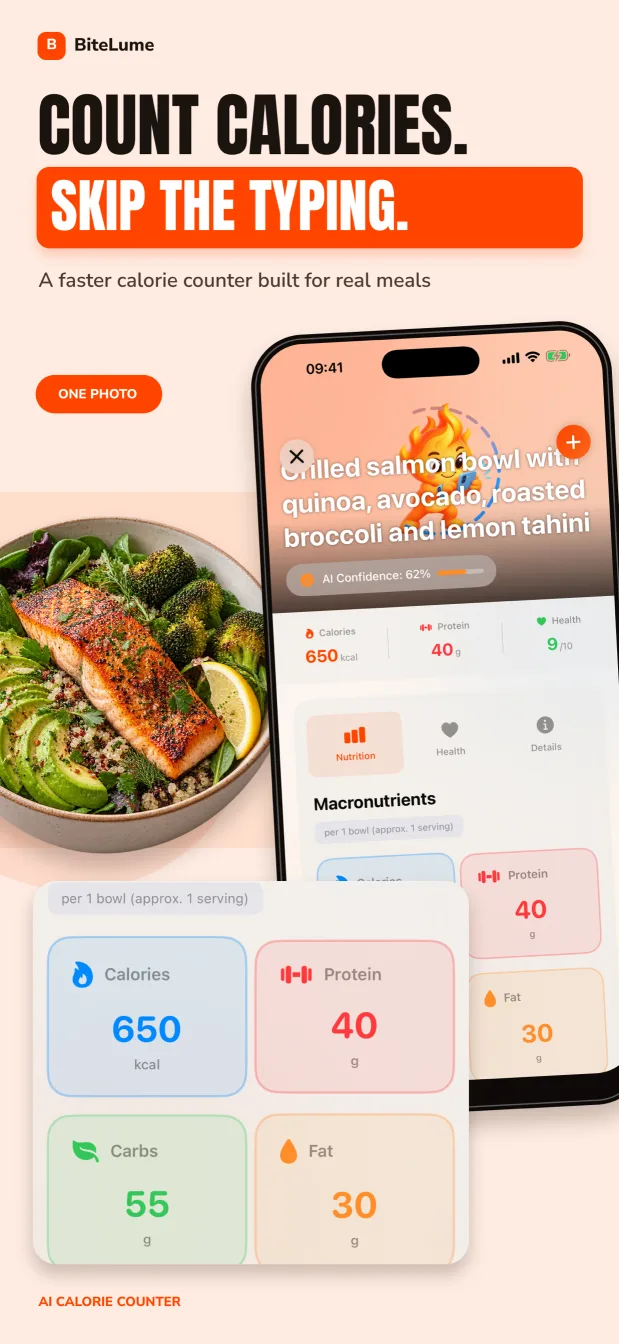
In BiteLume, photograph the full meal and review the suggested foods, portions, calories, protein, carbohydrate and fat. When a label or known recipe gives stronger information, compare that value with the scan rather than assuming the image is more precise. Account separately for anything the camera could not see, including cooking oil, dressing, a drink or a second portion.
The saved photo helps explain why an estimate exists. If tomorrow's lunch looks similar but the result is very different, compare the detected components and portion assumptions instead of accepting the number blindly. The food diary then becomes a record you can audit rather than a stream of isolated totals.
Use BiteLume's daily and longer-term views to look for broad patterns, not to declare one uncertain meal right or wrong. A repeatable reviewed workflow is more useful than chasing agreement between every app on every plate.
Questions people also ask
Why do calorie apps show different calories for the same food?
They may use different serving sizes, brands, recipes, cooking states, database records or visual portion estimates. Convert both results to the same amount and compare the food description and source before deciding whether they truly disagree.
Which calorie app estimate is more accurate?
The better estimate is the one supported by stronger evidence for your exact food and portion. Prefer a current package label, restaurant listing, closely matched authoritative database entry or documented recipe over a vague generic match.
Can two different calorie numbers both be reasonable?
Yes. Natural food variation, recipe differences, label rounding and uncertain portions can create a range of defensible estimates. Small differences may be less important than using one transparent method consistently.
What should I do when an AI food scan looks wrong?
Compare the detected foods and portions with the meal. If the scan misses or misidentifies something, do not assume its total covers that item; account for it in your own reviewed calculation. Use a label, recipe or measured amount whenever it gives better evidence than the image.
Make the next meal easier to track.
Use a photo to get a calorie and macro starting point, review the details, and keep your progress in one place.