Set the scale to grams, place the plate or bowl on it and press tare. Add the food and note the displayed grams. Multiply the food's calories per gram by the weight you will eat, or use: calories per labeled serving × grams eaten ÷ grams per serving. Match raw food with raw data and cooked food with cooked data. Tare again between separate components.
- National Institute of Standards and Technology — SI Units: Mass
- U.S. Food and Drug Administration — How to Understand and Use the Nutrition Facts Label
- USDA FoodData Central — Data Type Documentation
- USDA Agricultural Research Service — Procedures for Estimating Nutrient Values for Food Composition Databases
Set up the scale for a clean measurement
Use a digital kitchen scale that displays grams and has a tare or zero button. Place it on a firm, level counter; a towel, soft mat or uneven table can make the reading unstable. Make sure the container does not touch another object.
Grams are usually the simplest unit because package labels and food databases commonly provide a gram weight. A fluid ounce measures volume while an ounce on a food scale measures mass, so switching between them without noticing can produce a large error. Milliliters and grams are close for water but not automatically interchangeable for oil, syrup or other foods with different density.
A home scale supports a practical estimate; it is not a laboratory instrument. Extra decimal places do not make a measurement more accurate than the device allows. For ordinary meal tracking, whole grams are enough.
- Use a stable, level surface.
- Select grams before adding food.
- Keep the container clear of nearby objects.
- Wait for the display to settle before recording.
- Use whole grams unless the scale and task justify finer precision.
Use tare to weigh food without the plate
Tare subtracts the weight already on the scale. Put the empty plate, bowl or pan on the scale, press tare and wait for zero. Add the food. The display now shows the food's weight rather than the combined food-and-container weight.
For a meal with separate components, record the first weight, press tare again and add the second food. Repeat as needed. This is quick for rice, chicken and vegetables, but do not lose track of which number belongs to which item. A note on your phone can prevent a row of unlabeled gram values.
If the scale turns off between ingredients, the tare relationship may be lost. Remove everything and restart rather than subtracting several uncertain numbers from memory. For a hot pan or very large dish, use a heat-safe support if the manufacturer allows it, or transfer the food to a suitable container instead of risking damage to the scale.
- Place the empty container on the scale.
- Press tare and confirm the display returns to zero.
- Add the first food and record its gram weight.
- Press tare again before adding a separate component.
- Match every weight to the correct food record.
- Record the amount actually eaten, not only the amount served.
Taring resets the display for convenience. You still need to record every calorie-containing component you add after each reset.
Calculate calories from a package label
Find the calories and gram weight for one labeled serving. If peanut butter lists 190 calories per 32 grams and your portion weighs 24 grams, calculate 190 × 24 ÷ 32. The result is about 143 calories. Use the same ratio for protein, carbohydrate, fat or other nutrients when needed.
Do not use the front-of-package wording instead of the Nutrition Facts serving. “About 100 calories” may refer to a specific piece count or prepared form. Check whether the label describes the product as sold or after preparation, and whether the grams cover one serving or the whole package. Labels use regulatory rounding, so keep the result sensibly rounded too.
Swipe to see the full table
| Step | Peanut butter example | Result |
|---|---|---|
| Read label | 190 calories per 32 g | Reference serving |
| Weigh portion | 24 g | Amount served |
| Calculate | 190 × 24 ÷ 32 | 142.5 calories |
| Round sensibly | About 143 calories | Practical entry |
Related: See how portion assumptions change calorie estimates
Try negative weighing for jars and shared packages
Negative weighing can be faster for spreads, oils and foods served directly from a package. Put the jar or bottle on the scale, press tare, remove the amount you will use and return the package to the scale. The display shows a negative number; its absolute value is the grams removed.
For example, if the display reads −18 grams after spooning yogurt into a bowl, record 18 grams. This method avoids balancing the serving dish on the scale and can capture what left a bottle more easily than trying to place a pan under a stream of oil.
Do not confuse product removed with product eaten. Adjust for substantial leftovers, but do not turn ordinary residue into an elaborate calculation. Wipe the package before weighing when sauce or moisture on the outside could affect the reading.
Swipe to see the full table
| Food | Convenient method | Watch for |
|---|---|---|
| Peanut butter | Weigh jar before and after serving | Food left on the utensil |
| Cooking oil | Tare bottle, pour, replace bottle | Oil added to pan but later discarded |
| Yogurt | Negative weigh the tub or tare the bowl | Shared spoon and bowl residue |
| Cereal | Tare bowl, then pour | Adding milk before recording cereal |
| Cheese block | Tare block before slicing | Rind or wrapper included in the measurement |
Match raw and cooked weights to the right data
Water makes raw-versus-cooked matching important. Meat often loses water during cooking, so 100 grams cooked can contain more calories per gram than 100 grams raw even when no extra calories were added. Rice and pasta absorb water, so their cooked weight rises and their calories per 100 grams fall. The total energy of the original food is distributed across a different finished weight.
If you weigh chicken raw, use a raw record that matches the cut and whether skin is present. If you weigh it after cooking, use an appropriate cooked record. Do the same for grains. Do not weigh dry pasta and multiply by a cooked-pasta value, or weigh cooked pasta and apply the dry value.
For the most repeatable batch method, calculate the ingredients in the state measured, then weigh the finished edible recipe. Account for calorie-bearing additions and any material food discarded during cooking—such as rendered fat, drippings, marinade or cooking liquid—before dividing the remaining batch calories by its finished grams. This handles water gain or loss without pretending energy that left the pan was eaten.
Swipe to see the full table
| You measured | Use this kind of record | Common mismatch |
|---|---|---|
| Dry rice | Dry rice | Applying a cooked-rice value |
| Cooked rice | Cooked rice | Applying the dry package grams directly |
| Raw chicken breast | Raw, matching skin and cut | Using roasted chicken per 100 g |
| Cooked chicken breast | Cooked, matching method | Using a raw record without yield adjustment |
| Finished mixed recipe | Calculated recipe per finished gram | Dividing by raw ingredient weight |
Weigh a batch recipe and the portion you eat
Record every ingredient that contributes meaningfully to the batch, using the package label or a closely matched food-database entry. Add their calories, then estimate and subtract any meaningful calorie-bearing fat, sauce or cooking liquid that was discarded rather than eaten. Weigh the empty cooking or storage container, then weigh it with the finished food and subtract the container to obtain the edible yield.
Suppose a pot contains 2,400 calories and the finished food weighs 2,000 grams. That is 1.2 calories per gram. A 350-gram serving is about 420 calories. If you leave 70 grams, the eaten amount is 280 grams, or about 336 calories. This method works even when portions are unequal.
Recalculate when the recipe materially changes. A different amount of oil, cheese, meat or sauce can make an old per-gram value misleading. For small variations, note the difference rather than rebuilding the record solely to produce an artificially exact result.
- Total the ingredients using the state and amount actually measured.
- Account for meaningful calorie-bearing additions or discards.
- Subtract the empty container from the finished batch weight.
- Divide batch calories by finished edible grams.
- Multiply calories per gram by each served portion.
- Subtract meaningful leftovers from the served weight.
Use the scale selectively, not automatically
A scale is valuable when visual portion estimates vary widely, a calorie-dense ingredient is easy to overpour or a repeat recipe is worth calculating once. It is less useful when an exact single-serve package already supplies the information, when weighing would disrupt a social meal or when the remaining uncertainty comes from an unknown recipe rather than portion weight.
Practice can reduce dependence on the scale. Weigh a usual cereal bowl, spoonful of peanut butter or serving of rice a few times, then compare later portions visually. Recheck occasionally or when the container changes. The aim is to learn useful anchors, not to make every meal conditional on a device.
If weighing food becomes rigid, distressing or interferes with eating normally, stop and seek qualified support. A kitchen scale and calorie app are general-wellness tools; they cannot decide whether detailed tracking is appropriate for an eating disorder, medical condition or therapeutic diet.
Combine the scale with BiteLume when weight adds value
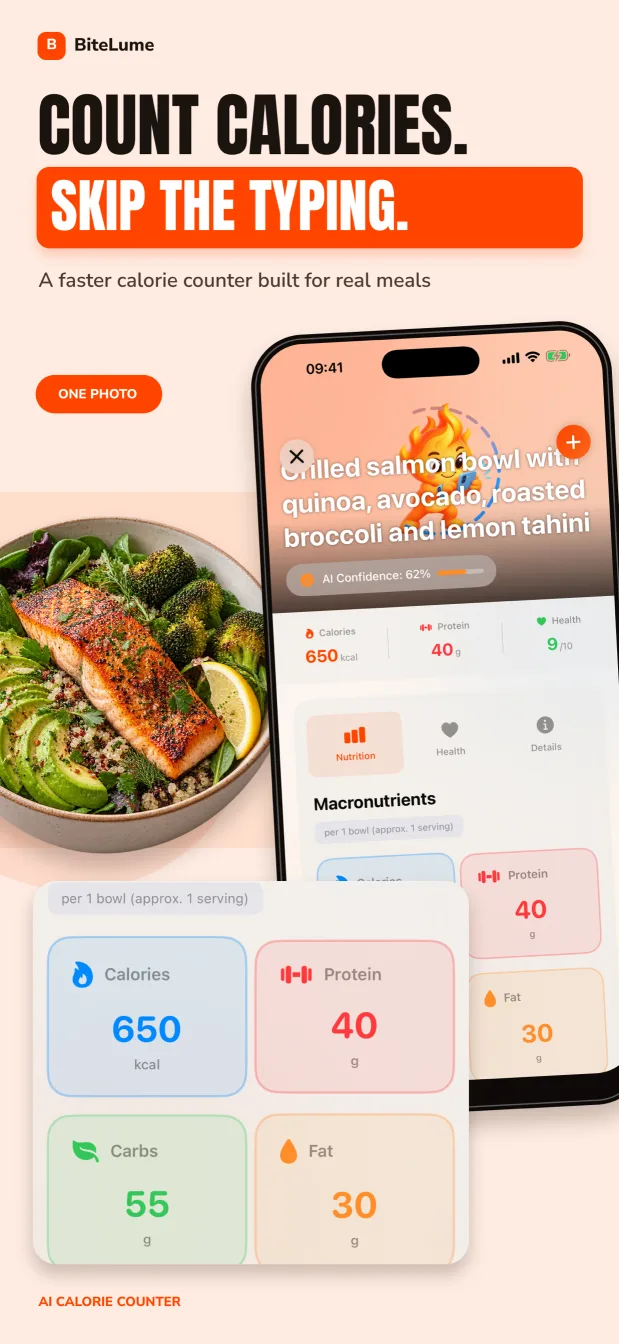
Take a meal photo in BiteLume to capture the full plate and receive a starting estimate for visible foods, portions, calories and macros. When one component is easy to weigh—such as rice, meat or a measured dressing—use that gram value to review the suggested portion instead of replacing the entire photo workflow with manual entry.
Account in your calculation for ingredients the camera cannot verify, particularly oil, sauce, sweetened drinks and fillings. For a batch recipe, use the calculated calories per gram and the portion weight. For an ordinary mixed meal, keep the estimate rounded and record for yourself what was measured versus inferred.
This hybrid approach keeps the scale focused on the uncertainties it can actually solve. The photo preserves context, the weight helps you judge a specific portion and BiteLume's food diary keeps the scanned meal alongside daily and longer-term patterns.
Questions people also ask
How do I calculate calories from a food scale?
Weigh the food in grams, find calories and grams for the same food and preparation, then use: listed calories × grams eaten ÷ listed grams. For a label showing 190 calories per 32 grams, a 24-gram portion is about 143 calories.
Should I weigh food raw or cooked for calorie tracking?
Either can work if the data match. Use a raw record for a raw weight and a cooked record for a cooked weight. For recipes, ingredient totals plus the finished batch weight give the most repeatable portion calculation.
What does tare mean on a kitchen scale?
Tare resets the displayed weight to zero while a plate, bowl or earlier ingredient remains on the scale. It lets you measure only the next food added without manually subtracting the container.
Do I need to weigh every food to count calories?
No. Use a scale when portion weight would resolve an important uncertainty or teach you a repeatable reference. Labels, familiar portions, recipes and reviewed photo estimates can be more practical in other situations.
Make the next meal easier to track.
Use a photo to get a calorie and macro starting point, review the details, and keep your progress in one place.