At a buffet or potluck, take one clear photo of your first plate and another of any refill or dessert. Keep foods visible, note serving counts and use familiar references such as a spoon, cup or package when available. Review BiteLume's estimate for hidden oil, sauces and dense mixed dishes, then account for leftovers. The result is a planning estimate, not a laboratory measurement—and one social meal does not require compensation afterward.
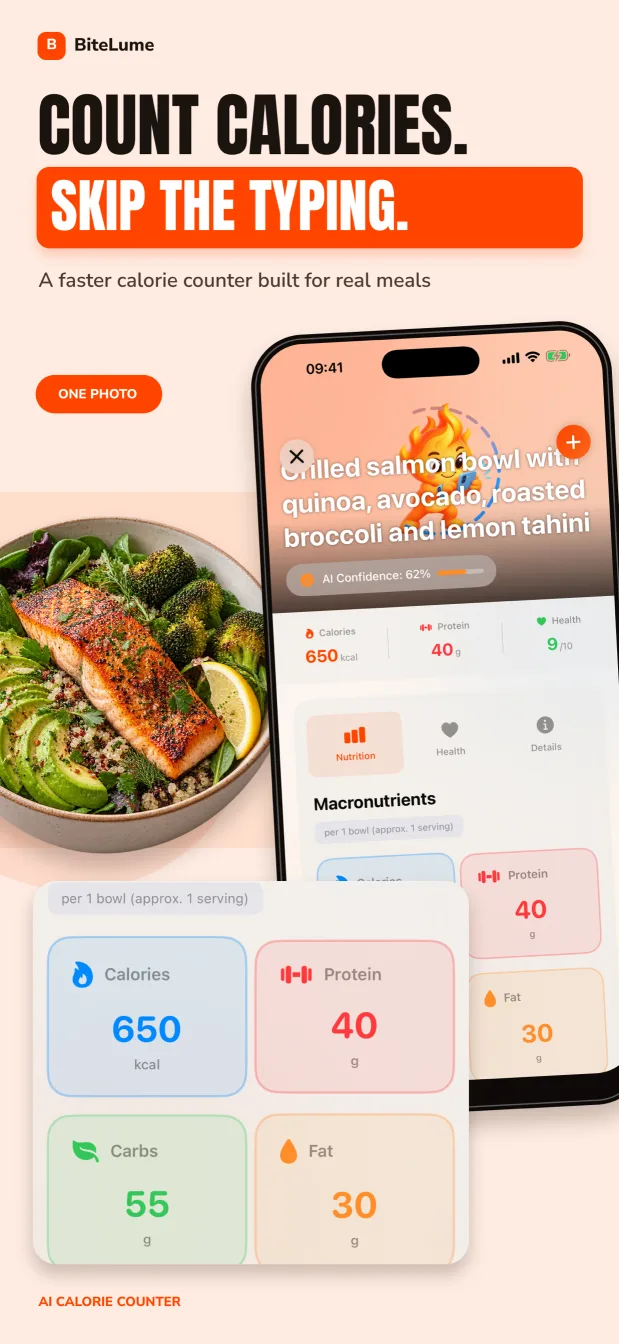
At a buffet, useful accuracy means an honest range
A buffet combines nearly every difficult tracking condition: recipes are unknown, serving spoons vary, foods overlap and people return for seconds. A potluck adds home recipes that may not have labels at all. No photo app or database can recover exact ingredient weights from that evidence. The useful goal is a plausible, complete account of what you ate, not a total presented to the last calorie.
Completeness usually matters more than fine distinctions. Forgetting two drinks, a creamy dressing and a dessert can change the record more than choosing between two similar entries for roasted vegetables. First capture every eating occasion. Refine portions and recipes only where the choice could change your interpretation.
Treat the estimate as general-wellness information. If you must follow a clinician-directed limit for carbohydrate, sodium, allergens or another nutrient, an unlabeled shared buffet may require advance questions, known dishes or a different meal plan. A visual estimate is not a safe substitute for ingredient disclosure or individualized medical guidance.
A buffet is one eating occasion, not a debt. Return to your ordinary routine afterward rather than skipping meals, severely restricting food or using exercise as compensation.
Related: Estimate restaurant food when nutrition data is missing
Take a ten-second survey before filling the plate
Walk past the options once if the setting allows it. This is not about finding the lowest-calorie food; it is about making a deliberate first plate instead of discovering a preferred dish after the plate is already crowded. Notice the foods you genuinely want, any familiar protein or vegetable dishes, sauces served separately and items that are difficult to identify.
Ask simple questions when they matter. The person who brought a casserole may know the main ingredients, and a restaurant buffet may display allergen or menu information. You do not need to interrogate the cook for a tracking estimate. A short description such as chicken curry with coconut milk is already more useful than selecting generic chicken from a database.
Start with a plate that leaves food edges visible. Overlapping layers make both human review and a photo estimate harder. If you want more later, a second photographed plate is easier to account for than one piled plate whose portions cannot be separated.
- Survey the full table before choosing.
- Pick the foods you most want rather than sampling automatically.
- Ask about a recipe only when the answer affects safety or the estimate.
- Keep portions distinct enough to recognize in a photo.
- Photograph the plate before beginning to eat.
Build the estimate from visible portions
Begin with countable items: one roll, two meatballs, a slice of pie or three small pieces of sushi. Then estimate foods served by volume, such as roughly half a cup of rice or one ladle of soup. Familiar utensils can provide context, although serving spoons and ladles are not standardized measuring tools. Avoid converting a rough spoonful into a highly specific gram weight.
For proteins and other irregular items, compare the portion with a familiar serving you have measured before. A hand-size reference can support consistency, but hands and food thickness vary, so it remains an approximation. When the item is packaged—such as a bottled drink or individual yogurt—the label is better evidence than its appearance.
Use the same database assumptions from one similar event to the next. If the recipe is unknown, a middle-of-the-road entry is often more defensible than automatically choosing the lowest or highest listing. Save a note such as restaurant-style, creamy or fried so the estimate can be understood later.
Swipe to see the full table
| Buffet evidence | Practical entry | Uncertainty to keep |
|---|---|---|
| Countable item | Record the number and approximate size | Pieces may differ in weight |
| Scoop or ladle | Estimate cups or a familiar serving | Utensils are not standardized |
| Packaged product | Use its current Nutrition Facts label | Confirm the amount consumed |
| Carved or sliced food | Estimate number, size and thickness | Fat and preparation may be hidden |
| Unknown homemade dish | Choose a close mixed-dish match and add a note | Recipe and oil remain unknown |
Handle mixed dishes, oils and sauces separately
Casseroles, curries, pasta salads and dips compress many ingredients into one visible shape. Identify the dish type, main ingredients and whether it appears creamy, oily, fried or broth-based. If the cook shares a recipe, use it only if the batch and portion can be estimated reasonably. Otherwise, select a comparable prepared dish and avoid pretending it is an exact match.
Sauces deserve their own line when they are added at the table. Record the number of spoonfuls or packets. For sauce already mixed through a dish, choose an entry that represents the prepared food rather than logging plain ingredients. The same principle applies to butter on bread, oil on grilled vegetables, cheese on a salad and sugar or cream in coffee.
A photo cannot show oil absorbed during cooking or the proportion of dressing at the bottom of a bowl. BiteLume can offer a visual starting point, but your knowledge of the dish should help you judge whether the result is reasonable. When the difference is unknowable, keep a practical range in mind and move on. False precision does not make the entry more truthful.
- Log table-added sauces, dressings and spreads as separate items.
- Choose prepared-dish entries for foods already mixed with sauce.
- Record obvious preparation clues such as fried, creamy or oil-dressed.
- Prefer a known recipe only when it genuinely matches the served batch.
- Use an uncertainty note instead of inventing ingredient weights.
Give seconds, drinks and small tastes their own moment
Refills are easy to miss because the first plate feels like the official meal. Photograph every additional plate, even when it contains only one item. If you return for a smaller amount of the same food, record it as another portion rather than enlarging the first plate from memory later.
Keep beverages visible. Beer, wine, cocktails, punch, juice, sweetened soft drinks and coffee additions can all contribute energy while remaining outside the food photo. Use the can, bottle or serving size when known. Mixed drinks vary substantially with the pour and added syrups, so use a reasonable recipe match and acknowledge the range.
Dessert samplers and tastes still belong in the record, but do not turn the event into an accounting exercise between every bite. Group several small tastes into one photographed plate. If you share dessert, estimate your fraction. If you leave food, compare the before and after plates and log the amount eaten rather than the amount served.
Swipe to see the full table
| Often missed | Capture method | Review question |
|---|---|---|
| Second plate | Take a new overhead photo | Is any food repeated from plate one? |
| Drink refill | Keep the container or note the glass count | Was it sweetened or mixed? |
| Dessert tastes | Place them together for one photo | Did you eat every sample? |
| Shared item | Note your approximate fraction | How many people shared it? |
| Leftovers | Compare what remained | Was the served portion fully eaten? |
Use a three-photo BiteLume workflow
For many buffet meals, three photos are enough: the first plate, any second plate and dessert or late additions. In BiteLume, scan each photo separately so foods and portions stay distinguishable in the diary. Review the identified items, calorie estimate and macros while the meal is still fresh. Account separately for drinks and table sauces that were outside the frame.
Check the obvious facts first. If a food is misidentified or a countable portion is implausible, treat the scan only as a starting point. Compare it with a current package label when one genuinely matches. Then account for hidden ingredients you know about; do not choose a number merely because it is the one you hoped to see.
After saving, let the entry remain an estimate. The diary's value is that the meal is represented alongside ordinary days, not that an unknowable recipe has been reverse-engineered. Weekly progress views can provide context, but one buffet total should not trigger a dramatic change to goals or routine.
- Photograph the complete first plate in good light.
- Scan and confirm the main foods and visible portions.
- Create a new entry for seconds, dessert or later snacks.
- Account for drinks, sauces and known preparation details outside the scan.
- Compare the served amount with sharing and leftovers, then save only a reasonable estimate.
Keep food safety and health needs ahead of tracking
Shared food needs safe handling. Perishable dishes should not remain at room temperature indefinitely, and hot or cold holding guidance matters more than preserving a calorie estimate. Follow the host's or venue's food-safety practices, avoid cross-contamination and discard food when its safety is uncertain. Photographing a plate is never a reason to delay eating hot food for an extended setup.
People with allergies cannot rely on a photo or calorie database to establish ingredients or cross-contact. Ask the preparer or venue directly, and choose a known alternative when the answer is unclear. Similar caution applies to clinician-directed diets that depend on precise carbohydrate, sodium or other nutrient amounts.
If tracking makes the social event feel dominated by fear, guilt or compensatory plans, the healthiest move may be not to calculate the meal. Resume your normal eating routine and consider support from a registered dietitian or qualified clinician. BiteLume is designed for general wellness and cannot replace that individual care.
Questions people also ask
How do I count calories at a buffet without weighing food?
Photograph each plate, record countable items and estimate scoops with familiar cup or serving references. Add sauces, drinks, desserts and seconds separately. Use a comparable prepared-dish entry for unknown recipes and treat the total as a range rather than an exact measurement.
Should I log every food I taste at a potluck?
Represent tastes that you consumed, but keep the method practical. Place several samples on one plate and take a photo, or make one combined note. Completeness matters; precise gram estimates for every tiny bite usually do not.
How do I estimate calories in an unknown casserole?
Identify the dish type, main visible ingredients, preparation and portion volume. Choose a similar prepared-dish database entry, add known toppings or sauces and note that the recipe is unknown. Ask for the recipe only when it is available and relevant.
Can BiteLume scan multiple buffet plates?
Yes. Photograph and review each plate or course as its own saved meal so repeated foods and portions stay visible in the diary. Account separately for calorie-containing drinks, table sauces, shared items and leftovers that the photos do not fully explain.
Make the next meal easier to track.
Use a photo to get a calorie and macro starting point, review the details, and keep your progress in one place.