You can eat the same calories on rest days and workout days if the weekly pattern supports your needs and feels sustainable. You can also vary intake, especially around demanding training, but do not treat wearable calorie-burn numbers as exact. Keep protein and overall diet quality consistent, watch energy, performance and recovery, and compare several weeks rather than one day. Athletes or anyone with medical, pregnancy or eating-disorder concerns should seek individualized guidance.
- NIDDK — About the Body Weight Planner
- U.S. Department of Health and Human Services — Physical Activity Guidelines for Americans
- Academy of Nutrition and Dietetics, Dietitians of Canada and ACSM — Nutrition and Athletic Performance
- British Journal of Sports Medicine — 2023 IOC Consensus Statement on Relative Energy Deficiency in Sport
- Dietary Guidelines for Americans
- Journal of Physical Activity and Health — Systematic review of wearable energy-expenditure validity
Both steady and flexible calorie patterns can be reasonable
Your body does not close an energy ledger at midnight. Food intake and energy expenditure vary across hours and days, while body weight and training adaptation reflect longer patterns. That is why eating the same amount daily can coexist with different activity days. The steady target spreads weekly intake evenly and removes one daily calculation.
A flexible pattern can also make sense. A long run, extended ride, tournament or demanding strength session may create different fueling and recovery needs than a quiet day. Some people naturally feel hungrier and perform better with more food around those sessions. Others prefer consistent meals and find that frequent target changes create noise.
The useful question is not which rule is universally correct. Ask which pattern supplies enough energy and nutrients, supports the activity you actually do and remains easy to follow without guilt or compensation. A calorie app offers general-wellness estimates; it cannot determine an individualized sports-nutrition or medical prescription.
Rest day does not mean zero-energy day. Basic body functions, ordinary movement and recovery continue even when no planned workout appears on the calendar.
Related: Understand why intake and burn estimates do not balance exactly
Exercise is only one part of daily energy use
Total energy expenditure includes resting needs, digestion, planned exercise and movement that is not a workout. A gym session may raise one component, but step count, job demands, household activity and spontaneous movement can change too. Two days labeled workout may have very different totals, and an active rest day can involve more movement than a desk-bound training day.
Wearables and cardio machines estimate exercise calories from limited inputs. Their numbers can be useful as a consistent activity signal, but they should not be treated as food vouchers with laboratory accuracy. Device algorithms, heart-rate response, exercise type and individual physiology all affect the result.
Avoid subtracting a device estimate from food intake to calculate an exact net calorie number. That combines uncertainty from both sides: food portions are estimated and exercise expenditure is estimated. Track them as related context, then judge the broader pattern with performance, recovery, hunger and longer-term trends.
Swipe to see the full table
| Daily factor | Why it can change | What the log can show |
|---|---|---|
| Planned training | Duration, intensity and exercise type differ | Session type and timing |
| Everyday movement | Work, errands, steps and chores vary | Activity overview, not exact burn |
| Food intake | Portions, recipes and appetite vary | Meals and reviewed estimates |
| Recovery | Sleep, soreness, stress and health affect response | A note for repeated patterns |
| Body-weight trend | Water and stored carbohydrate shift short term | Several weeks of context |
Sources for this section: Systematic review of wearable energy-expenditure validity
When the same calories every day may work best
A steady target is useful when simplicity improves consistency. You can plan repeat breakfasts, pack similar lunches and compare days without recalculating a target after every workout. It may also suit schedules where training intensity is moderate or where active and less-active days balance across the week.
Consistent does not mean identical meals. You can keep a similar daily calorie range while shifting meal timing or food choices. A pre-workout snack may replace food you would otherwise eat later, or a larger dinner may follow an evening session. The structure stays steady while the day remains flexible.
The risk is following the number despite clear signs that the plan does not support the routine. Persistent fatigue, declining performance, poor recovery, dizziness, recurrent injuries, menstrual changes or preoccupation with food deserve attention. Those concerns should not be solved by guessing a new app target; seek a qualified sports dietitian or clinician.
- Choose a steady pattern when fewer daily decisions improve follow-through.
- Use a range rather than treating one calorie as a hard ceiling.
- Move food around the day when training timing changes.
- Review several weeks before judging an ordinary fluctuation.
- Escalate health or under-fueling concerns to qualified care.
Sources for this section: IOC consensus statement on Relative Energy Deficiency in Sport
Related: Use weekly context without compensating for one day
When varying food around training may feel better
A flexible plan can align food with genuinely different demands. Someone completing a long endurance session may prefer an extra meal or larger carbohydrate portions around training. A person with a long competition day may need planned fuel during the activity. That is different from adding back every calorie displayed by a watch after an ordinary workout.
Keep the adjustment connected to the session, not to a reward system. Food supports training before, during and after; exercise is not a permission slip to eat. Likewise, reducing intake on a rest day should not become punishment for doing less. Rest and recovery are part of a training plan.
Start with a simple category rather than a new calculation every day: ordinary day, demanding training day and unusually long event day. Note what changed and how the session felt. If performance, recovery or health is important, an accredited sports dietitian can translate the training schedule into individualized energy, carbohydrate, protein and hydration guidance.
- Classify the session by its real demand, not merely whether it happened.
- Plan food around the session before relying on post-workout hunger.
- Use wearable calories as context rather than an amount to eat back exactly.
- Keep the change modest unless a qualified plan says otherwise.
- Review energy, performance and recovery across several similar sessions.
Look beyond the calorie total when fueling activity
Two days can have the same calories but support training differently. Carbohydrate availability, protein distribution, hydration and the timing of meals can matter for exercise and recovery. The exact approach depends on the sport, session duration, intensity, body size, goals and tolerance. General food logging can reveal what happened, but it cannot replace an individualized fueling plan.
Protein is useful across both workout and rest days because recovery continues outside the session. That does not require chasing the highest possible number. Record usual protein-containing meals, compare the pattern with qualified guidance for your needs and keep the rest of the diet visible. Carbohydrates and fats also have important roles; macros are not a hierarchy of virtuous and unimportant nutrients.
Hydration deserves context rather than a universal target. Weather, sweat, duration and medical factors change needs. BiteLume can keep water entries near meals and activity context, but thirst, symptoms or clinician advice should not be overridden by an app streak.
Swipe to see the full table
| Question | Useful observation | Avoid |
|---|---|---|
| Was the session fueled? | Meal or snack timing before training | Assuming total calories explain timing |
| Was recovery supported? | Food, hydration, rest and how you felt | Judging recovery from one macro |
| Is protein consistent? | Protein-containing meals across the day | Ignoring the rest of the diet |
| Did activity differ? | Type, duration and ordinary movement | Treating all workout labels alike |
| Is the plan sustainable? | Hunger, energy and repeated behavior | Using guilt as feedback |
Sources for this section: Nutrition and Athletic Performance position statement
Compare weekly patterns, not isolated arithmetic
Review at least a few comparable weeks before deciding that the daily pattern needs changing. First check log quality: are meals, drinks and weekends represented? Then compare training structure, ordinary movement, hunger, energy and performance. Body weight can fluctuate with water, sodium, carbohydrate storage and digestion, so a single next-morning change does not reveal the effect of one rest day.
If a steady target feels easy and training is supported, there may be nothing to fix. If demanding sessions repeatedly coincide with low energy or unplanned late eating, planned food around those sessions may be worth testing. If flexible targets cause constant bargaining with the activity estimate, return to a steadier structure.
Change one element at a time and describe it plainly. For example: added a pre-training snack before Tuesday and Thursday sessions is more testable than optimized calories. Keep the experiment long enough to observe repeated sessions, and involve a qualified professional when performance or health consequences are meaningful.
- Confirm that food and activity records are reasonably complete.
- Compare similar training days rather than unrelated dates.
- Read weight as a trend with normal short-term fluctuation.
- Choose one practical fueling change to test.
- Keep or remove the change based on repeated evidence.
Use BiteLume to keep meals and activity in the same story
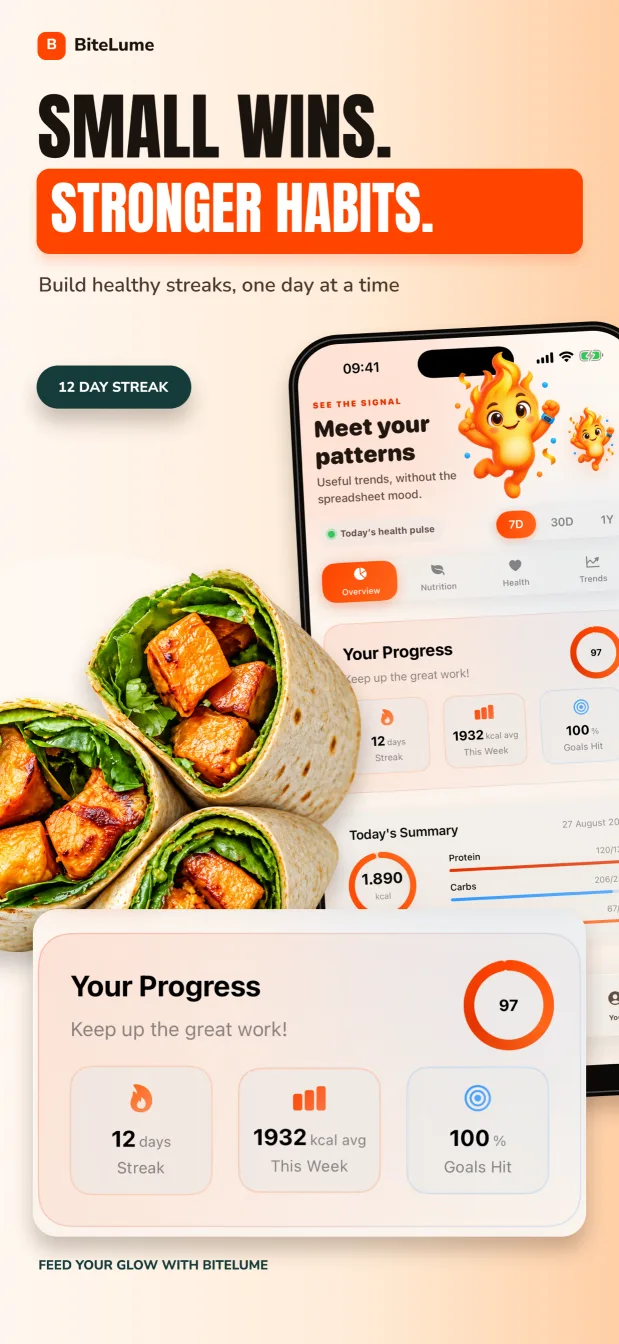
Photograph meals in BiteLume and review the estimated calories and macros against portions, labels and recipes. Use the daily overview to keep meals, water and movement context together. The activity overview is context, not a command to add or subtract an exact amount of food.
At the end of the week, compare repeated workout days with repeated rest days. Look for missing meals, late hunger, changes in meal timing or foods that were hard to estimate. The progress dashboard can help organize daily and weekly patterns, while goals and streaks can support a routine when they remain flexible.
Do not let a streak override health, hunger or a professional plan. BiteLume is a general-wellness tool, and its calorie, macro and activity values are estimates. People who are pregnant, under 18, training at a high level, managing a health condition or living with an eating disorder should use individualized guidance rather than a generic rest-day formula.
Questions people also ask
Should I eat the same calories on rest days and workout days?
You can. A steady daily amount is simple and can distribute weekly intake evenly. Some people prefer more food around longer or harder sessions. Judge the pattern by overall needs, health, performance, recovery and sustainability rather than a universal rule.
Should I eat back the calories my watch says I burned?
Do not assume the device number is exact. Wearables estimate energy expenditure, and food intake is also estimated. Use activity data as context, plan appropriate workout fueling and seek individualized advice when training demands or health consequences are significant.
Do I need less protein on rest days?
Recovery continues on rest days, so many active people keep protein-containing meals consistent. Your appropriate amount depends on body size, training and health. A sports dietitian can provide an individualized target without reducing the rest of the diet to one macro.
How can BiteLume compare workout and rest days?
BiteLume keeps meal photos, reviewed calorie and macro estimates, water entries and activity context in daily and weekly views. Compare repeated patterns and log completeness; do not treat its activity or food estimates as medical measurements.
- Understand why intake and burn estimates do not balance exactly
- Use weekly context without compensating for one day
- Put short-term scale changes after training in context
- Track protein without letting one number take over
- Choose a daily calorie starting point you can review
- Build meals that are not reduced to calorie arithmetic
Make the next meal easier to track.
Use a photo to get a calorie and macro starting point, review the details, and keep your progress in one place.