A food log records what you eat and drink so you can remember meals, review nutrition estimates and notice repeated situations. For seven days, capture every meal, snack and calorie-containing drink as soon as practical. Use a photo plus a short note, review portions and hidden ingredients, then look for one repeated pattern—not a perfect score. BiteLume can keep meal photos, estimated calories and macros together, but every photo result should be reviewed.
- Public Health Nutrition — Systematic review of dietary self-monitoring
- Journal of the American Dietetic Association — Self-monitoring in weight loss
- U.S. Food and Drug Administration — How to Understand and Use the Nutrition Facts Label
- USDA FoodData Central — Food Search
- NIDDK — Choosing a Safe and Successful Weight-loss Program
A food log is evidence, not a verdict
A food log can be as simple as seven dinner photos or as detailed as weighed ingredients with calories and macros. In every version, its first job is memory. Most people cannot reconstruct an ordinary Tuesday accurately several days later, especially small snacks, drinks, sauces and second servings. Recording close to the meal preserves details while they are still available.
The second job is comparison. A log lets you compare weekdays with weekends, packed lunches with takeout days or meals that felt satisfying with meals followed by an early snack. Those observations do not diagnose a condition or prove that one food caused an outcome. They give you better questions and a concrete record to discuss with a registered dietitian or clinician when professional guidance is needed.
Avoid treating the diary as a moral scorecard. Foods are not honest or dishonest, and a higher-calorie day is not a character failure. If the record starts producing guilt, compulsive checking, severe restriction or pressure to compensate with exercise, pause the process and seek qualified support. A tracking tool should make everyday decisions clearer, not make eating feel unsafe.
Examples include: Which meals do I forget to log? What happens on late-work days? Am I regularly missing breakfast? One clear question prevents the diary from becoming an endless collection of numbers.
Record enough to recognize the meal later
Start with what you consumed: meals, snacks, tastes while cooking and calorie-containing drinks. A photo is an efficient base because it preserves the combination and relative size of visible foods. Add a short note for anything the image cannot show, such as oil under roasted vegetables, dressing mixed through a salad, sugar in coffee, a filling inside a sandwich or the fact that you ate only half.
Portion detail should match your purpose. Package amounts and measured recipe portions are useful when they are already available. You do not need to weigh every blueberry to learn whether afternoon snacks keep disappearing from the record. On the other hand, a spoonful of nut butter, cooking oil or a large restaurant portion can materially affect a calorie estimate, so a known amount deserves a note.
Context is optional. Time, location, hunger or a simple phrase such as rushed lunch may help if it relates to your question. Skip fields you will not use. Sleep, mood, symptoms and exercise can become sensitive health information; record them only when useful, protect access to the diary and share it deliberately.
Swipe to see the full table
| Detail | Beginner version | Add only when useful |
|---|---|---|
| Food and drink | One photo or clear description | Brand, recipe or ingredients |
| Portion | Rough amount or package fraction | Weight or measured volume |
| Extras | Sauces, oils, toppings and refills | Exact measured amount |
| Context | Meal name and approximate time | Hunger, setting or relevant symptom |
| After eating | What was left | Fullness or a clinician-requested note |
Choose a format that survives a busy day
Paper works when you like writing and do not need nutrient calculations. A notes app is fast but can scatter photos and portions across entries. Manual calorie databases provide detail but can take time to search. Photo-first logging reduces the effort of capture, then asks you to review the estimate rather than trusting the camera as a measurement instrument.
You can mix methods. Photograph lunch in BiteLume, use the Nutrition Facts label for a packaged yogurt and use a saved recipe calculation for dinner. The strongest evidence available may differ by meal. Consistency means using a repeatable process, not forcing every food through the same input method.
Set a backup rule for missed moments. If you cannot log immediately, take a quick photo and return later. If there is no photo, write the main components without inventing exact grams. Mark uncertain entries as estimates. A visibly incomplete day is more informative than false precision.
- Keep the capture action under a minute whenever possible.
- Use labels for packaged foods and recipe math for repeat batches.
- Review photo estimates before accepting foods and portions.
- Record leftovers, shared items and second servings.
- Label uncertain or incomplete entries instead of hiding them.
Related: Build a photo-first food diary
A 7-day food-log plan for beginners
The first week is a practice period, not a test. Each day adds one small skill while keeping the basic task the same: capture what you eat and drink. Do not overhaul your meals simply because you are recording them. A representative week teaches you more about the current routine than seven unusually controlled days.
If a day is incomplete, continue at the next meal. Do not restart the challenge and do not restrict food to repair the data. Add an incomplete note and use the gap to improve your reminder or capture method. By day seven, the success measure is whether you understand the routine better, not whether every entry matches a target.
Swipe to see the full table
| Day | Small focus | End-of-day check |
|---|---|---|
| 1 | Photograph every meal and snack | Is every eating occasion represented? |
| 2 | Include drinks and coffee additions | Did any liquid calories stay outside the frame? |
| 3 | Note oils, sauces and toppings | What could the camera not see? |
| 4 | Review portions and package fractions | Did you eat one serving, the package or part of it? |
| 5 | Capture seconds and leftovers | Does the log show what was eaten rather than served? |
| 6 | Add one useful context note | Was the meal rushed, social, late or planned? |
| 7 | Review the week without grading it | What single pattern deserves a closer look? |
Review calorie and macro estimates without chasing perfection
A food photo does not reveal an exact recipe, ingredient weight or cooking method. Two visually similar bowls may contain different amounts of oil, cheese or dressing. When BiteLume estimates calories and macros, check whether the recognized foods match the plate, whether the portions are plausible and whether anything is hidden or missing. Use a current package label or saved recipe when it provides better evidence.
Precision should follow consequence. A broad estimate may be enough to compare lunch patterns. Someone following clinician-directed carbohydrate, sodium or energy guidance may need exact labels, measured portions and professional review. Do not use a general-wellness app as a substitute for diagnosis, treatment or individualized medical nutrition advice.
Expect small mismatches between calorie totals and macro arithmetic. Nutrition labels use rounding rules, and energy calculations can account for fiber, sugar alcohols or food-specific factors differently. Investigate large, practical discrepancies; do not spend the week reconciling every last calorie.
- Confirm that the detected foods match what you ate.
- Check the portion against the plate, package or recipe.
- Account for oils, sauces, drinks and items outside the photo.
- Compare the served amount with leftovers, sharing and second servings.
- Save a photo result only when it remains a reasonable estimate, and record uncertainty separately when needed.
Turn seven days into one useful observation
Review the sequence before the totals. Find the least complete day, then identify what made capture difficult. Perhaps snacks happened away from the phone, dinner was shared from serving dishes or the weekend had no routine. Solving that recording problem improves the next set of evidence before you draw conclusions from it.
Next, look for repetition. A single late dinner is an event; four late dinners are a pattern worth exploring. Notice meal timing, recurring omissions, frequently repeated foods and the situations around them. Keep observations descriptive: lunch was skipped on three meeting days is more useful than I was bad at lunch.
Choose one small experiment. Pack a visible snack before long meetings, photograph takeout before sharing it, or keep a measuring spoon near a frequently used oil. Repeat the log long enough to see whether the change helped. Avoid changing five things at once, because you will not know which action made the routine easier.
Swipe to see the full table
| Weak conclusion | Stronger observation | Possible experiment |
|---|---|---|
| Weekends ruin everything | Saturday entries miss afternoon snacks | Take a photo before eating away from home |
| Dinner is too high | Oil and shared sides are uncertain at dinner | Record the oil and photograph the first plate |
| I need more discipline | Logging drops during back-to-back meetings | Use a photo-now, review-later rule |
| The app should know exactly | Mixed dishes need recipe context | Save common ingredients or a batch calculation |
Keep the seven-day record together in BiteLume
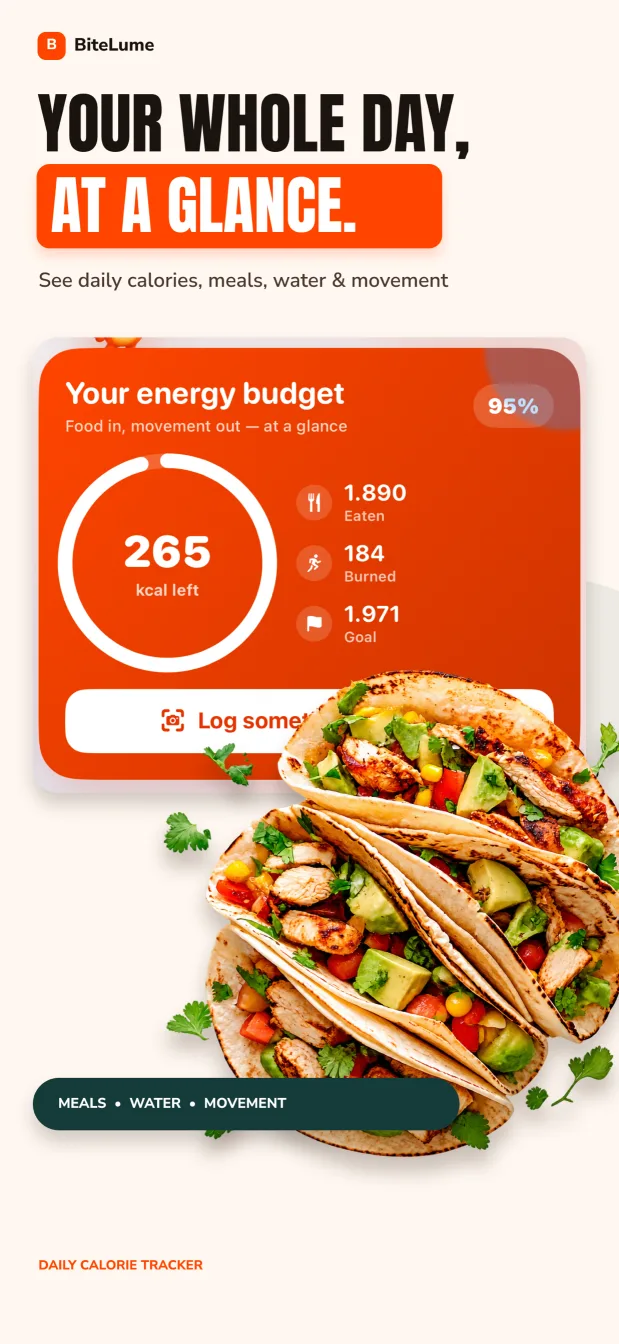
In BiteLume, photograph the complete meal before eating, then review the identified foods and estimated calories and macros. The diary keeps saved meals together with daily views of calories, water and activity context, while progress views can help you compare several days. Account outside the scan for details the image could not provide. These are general-wellness estimates and trends, not medical measurements.
Use the simplest reliable source for each entry. A product label should carry more weight than a generic visual estimate, a weighed batch can improve your homemade-portion calculation and a photo can preserve a restaurant meal that has no label. The point is not to make every entry equally exact; it is to keep the evidence and the uncertainty visible.
After seven days, keep the parts that helped and remove fields you ignored. A sustainable food log can be brief. One clear photo, one honest review and one weekly observation often produce more usable information than a complicated diary abandoned after two days.
Questions people also ask
What is a food log used for?
A food log helps you remember meals and drinks, review estimated nutrition and notice repeated situations such as skipped lunches or unrecorded snacks. It supplies evidence for a practical decision or a conversation with a qualified professional; it does not diagnose a health condition.
What should I write in a food log?
Record the food and drinks consumed, a useful portion description and easily missed extras such as oil, dressing, toppings or refills. A photo can hold the visible details. Add time, hunger or other context only when it serves the question you are studying.
How long should I keep a food diary?
Seven days is a practical first sample because it usually includes both weekdays and a weekend. Continue only if the record remains useful. A clinician may request a different duration or level of detail for an individual care plan.
Can BiteLume create a food log from meal photos?
BiteLume can keep saved meal scans with estimated calories and macros in a daily diary. Review every estimate against visible portions, product labels and recipes. If leftovers, second servings or hidden ingredients materially change the meal, include them in your own reviewed calculation rather than assuming the first photo captured everything.
Make the next meal easier to track.
Use a photo to get a calorie and macro starting point, review the details, and keep your progress in one place.