Pick one vacation tracking mode before you leave: detailed, photo-first, anchor-meal only or paused. When you log, use first-party menu nutrition where it exists and a complete meal photo plus a reasonable range where it does not. Include drinks, sauces, shared dishes and leftovers, but do not spend the trip reconstructing unknowable recipes. After a missed entry or planned break, resume with the next meal—without restricting, over-exercising or guessing to compensate.
- National Institute of Diabetes and Digestive and Kidney Diseases — Changing Your Habits for Better Health
- U.S. Food and Drug Administration — Menu Labeling Requirements
- CDC — Tips for Healthy Holiday Travel
- CDC Travelers' Health — Food and Drink Considerations When Traveling
- National Cancer Institute — Key Concepts About Measurement Error
Choose the level of tracking that serves the trip
Vacation changes meal timing, restaurant choices, portions and access to familiar foods. Trying to reproduce a precise home routine can create more work without creating more reliable data. Choose the smallest record that answers the question you care about.
A detailed log may fit a short business trip with packaged breakfasts and chain restaurants. A photo-first log can fit a holiday built around local cafés and shared dinners. Anchor-meal tracking records one or two predictable meals and leaves the rest as pictures or notes. A planned pause means no calorie entries for a defined period while you keep any photos you genuinely want.
None of these modes earns food or proves discipline. They are record-keeping choices. The National Institute of Diabetes and Digestive and Kidney Diseases describes setbacks and changing circumstances as normal parts of habit maintenance; the useful response is to regroup, not to treat one change in routine as failure.
Swipe to see the full table
| Tracking mode | What you record | When it may fit |
|---|---|---|
| Detailed | Meals, drinks, portions and known extras | A routine trip with strong label or menu data |
| Photo-first | Complete meal photos plus brief notes | Local restaurants and unknown recipes |
| Anchor meals | One or two repeatable meals; photos for the rest | A trip with predictable breakfast or snacks |
| Planned pause | No calorie totals; optional visual memories | When logging would reduce enjoyment or wellbeing |
Related: Estimate restaurant meals with an evidence-first checklist
Set three simple rules before leaving home
First, decide when you will capture a meal: before eating, after ordering or during one short evening review. A cue prevents the app from competing for attention throughout the day. Second, set a short time limit. A brief photo and review need not become a long search through generic restaurant entries.
Third, decide what uncertainty looks like. You might use a range for an unknown dish, select the closest cooking method, or keep only the photo. Write the rule down. Using the same uncertainty policy across the trip is more informative than choosing whichever estimate feels best in the moment.
Pack no special equipment unless it would already be useful. A food scale is rarely necessary for a leisure trip. Your phone, menu or receipt, package labels and familiar portion references provide enough context for a practical record.
- Choose detailed, photo-first, anchor-meal or paused tracking.
- Choose one capture cue and a short time limit.
- Choose how you will mark unknown portions and recipes.
- Download or update BiteLume before travel if you plan to use it.
- Treat the plan as adjustable when the trip changes.
Use the strongest food information available in each setting
At a covered U.S. chain, menu calories are available for standard items, and additional written nutrition information must be provided on request. Match the exact restaurant, item, size and standard customization. The same brand can use different products or recipes by country, so do not carry a U.S. listing into another storefront without checking.
For a packaged airport snack, start with serving size and servings per container. For a hotel buffet, build one plate before photographing it and note seconds separately. For an independent restaurant, keep the menu description and split the meal into visible components instead of inventing a precise recipe.
Use first-party information before crowdsourced estimates, and use a well-matched comparison before a loosely similar food. A local pastry and a packaged pastry may share a name while differing in size and filling. When uncertainty remains, the honest result may be a range.
- First-party package label or chain menu for a matching item
- Known recipe or ingredient information from the venue
- Complete meal photo and menu description
- Comparable food matched by portion and preparation
- Clearly marked estimate or photo-only record when evidence is weak
Related: Track prepared food when no nutrition information is published
Photograph restaurant and shared meals before the evidence disappears
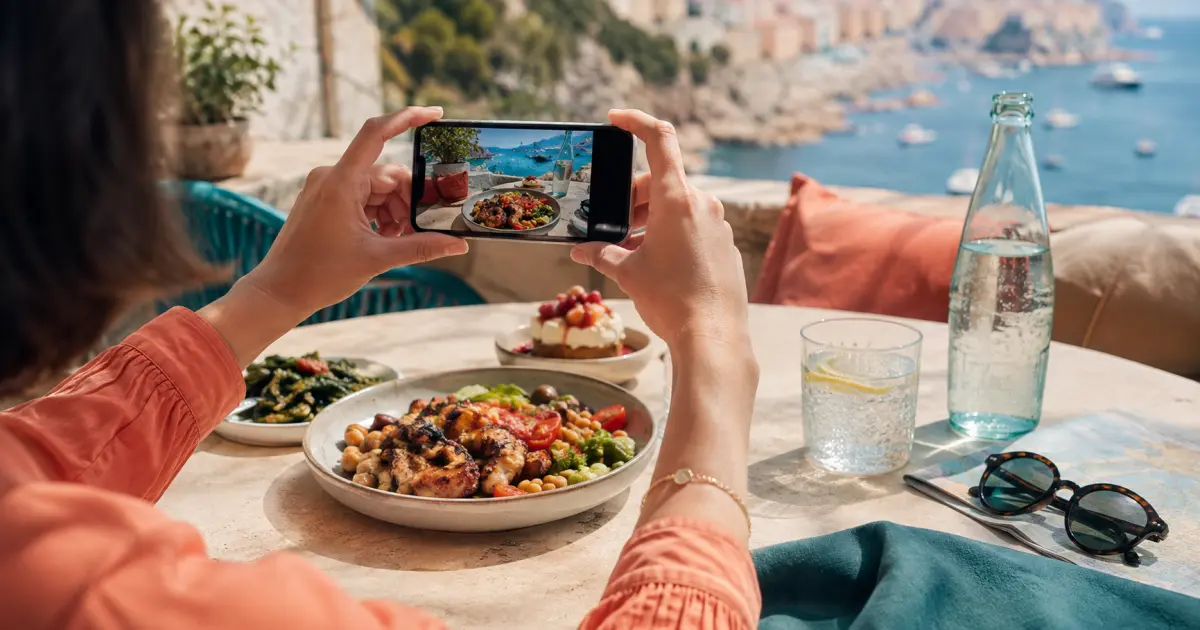
Capture the entire eating occasion: plate, side dishes, dips, bread, calorie-containing drinks and visible toppings. A slightly wider image is more useful than a beautiful close-up that excludes half the meal. Keep a familiar object or standard utensil in view when it naturally helps with scale.
For family-style food, photograph the serving dishes and your own plate. You do not need to count every spoonful while people are eating. Record your first portion, note meaningful seconds and adjust for food left behind. Shared sauces and pitchers can be described as a rough fraction only when that fraction is plausible.
Ask simple questions when the answer is readily available: grilled or fried, sauce on the side or mixed in, one serving or made for sharing. Do not turn the meal into an interrogation. Preparation details that change the estimate matter; an unknowable spice blend usually does not.
Make travel days easier with anchors, not perfection
Airports, road stops and schedule changes make food decisions fragmented. An anchor can reduce the number of decisions: a familiar breakfast, a packaged snack with a readable label, or a bottle of water carried for convenience. The CDC's travel guidance suggests planning portable snacks and choosing water or low-calorie drinks while traveling, but your practical choice still depends on access, allergies, culture and personal needs.
Record small eating occasions if you want a complete log. Samples, lounge snacks and drinks are easy to forget because they do not look like meals. One wide photo can preserve several small items, followed by a short note about what was actually eaten.
Food safety outranks logging. The CDC advises travelers to consider safe food and water practices, especially where contamination risk is higher. Do not keep a perishable snack unrefrigerated merely because it is easier to track, and seek medical care for travel illness rather than trying to solve symptoms through a food diary.
Photograph the complete eating occasion, write one line for hidden extras or portions, and move on. Review later only if the information will change a decision.
Resume after a missed meal without reconstructing the impossible
If you forget a meal, use what remains: a photo, receipt, menu, message or memory of the main components. Make one reasonable entry if it is useful. Do not search for an exact total when the portion and recipe are unknown, and do not fill the gap with a number chosen to make the day look tidy.
Resume with the next meal. There is no need to skip food, dramatically lower the next day's target or add exercise to erase the gap. Compensation can turn a simple logging omission into an unhelpful cycle.
A planned pause needs no backfill. When the pause ends, restart your normal capture cue. If calorie tracking causes guilt, fear or compulsive behavior, stop and seek support from a qualified health professional.
Use BiteLume for a fast vacation record
Open BiteLume when the complete meal arrives, take one clear photo and review the identified foods, portions and estimated calories and macros. Compare the result with what you know about dressings, cooking fats, drinks or shared dishes that the image cannot show. Use menu or label information when it is stronger than the visual estimate.
Save the result, then return to the trip. The photo remains valuable even when the calorie estimate is broad because it documents what was served and can support a later pattern review. BiteLume is a general-wellness tool, not a medical device, and its photo-derived nutrition values remain estimates.
After returning home, review the trip only if doing so answers a useful question: Which meals were easiest to capture? Did drinks or shared plates disappear from the frame? Would photo-only mode be better next time? Avoid using a vacation average as a verdict on progress or wellbeing.
Questions people also ask
Should I count calories while on vacation?
Only if the record is useful and does not interfere with the trip or your wellbeing. A detailed log, photo-only record, anchor-meal approach or planned pause can all be reasonable depending on your needs.
How do I estimate restaurant calories on vacation?
Use first-party menu nutrition for a matching standard item when available. Otherwise, photograph the full meal, break it into visible components, account for sauces and drinks, and use an honest range when the recipe or portion is unknown.
What should I do if I miss a day of calorie tracking?
Resume with the next meal. Backfill only what you can support from photos, labels, menus or receipts, and do not restrict food or add exercise to compensate for an incomplete log.
How can I use BiteLume while traveling?
Photograph the complete meal, review BiteLume's estimate and compare it with local menu or package information when available. Local recipes and portions may be unfamiliar or hidden, so treat unknown dishes as estimates.
- Estimate restaurant meals with an evidence-first checklist
- Track prepared food when no nutrition information is published
- Use consistent portion cues without packing a food scale
- Restart a food log without treating gaps as failure
- Use a low-friction routine on crowded days
- Keep a useful visual food record without demanding exact totals
Make the next meal easier to track.
Use a photo to get a calorie and macro starting point, review the details, and keep your progress in one place.