One food Calorie is one kilocalorie, written kcal. Using the thermochemical conversion, 1 kcal = 4.184 kJ. Divide kJ by 4.184 to obtain kcal, or multiply kcal by 4.184 to obtain kJ. Do not add the kJ and kcal figures together, and keep per-serving values separate from per-100-gram or per-100-milliliter values.
Calories, kilocalories and kilojoules describe energy
In everyday nutrition, a food Calorie normally means a kilocalorie. The abbreviation kcal makes that scale explicit. A kilojoule, written kJ, expresses the same kind of quantity using another unit. Neither unit tells you whether the portion is appropriate for you.
Food-label conventions vary by market. Food Standards Australia New Zealand describes panels showing energy in kilojoules or in both kilojoules and kilocalories, alongside nutrient quantities. An imported package may therefore look unfamiliar even when the food is ordinary.
Sources for this section: FSANZ: nutrition information panels
Related: Check serving size and the entire-container calculation
Use one conversion, then keep the rounding sensible
To convert kJ to kcal, divide by 4.184. For example, 1,000 kJ ÷ 4.184 is about 239 kcal. To convert kcal to kJ, multiply by 4.184: 200 kcal × 4.184 = 836.8 kJ.
Labels round their values, so figures printed in both units may not reproduce each other perfectly when converted from the displayed numbers. Use the relevant printed value and portion basis when available instead of treating a small rounding difference as a different food.
Swipe to see the full table
| Energy in kJ | Approximate energy in kcal | Calculation |
|---|---|---|
| 100 kJ | 24 kcal | 100 ÷ 4.184 |
| 500 kJ | 120 kcal | 500 ÷ 4.184 |
| 1,000 kJ | 239 kcal | 1,000 ÷ 4.184 |
| 2,000 kJ | 478 kcal | 2,000 ÷ 4.184 |
Sources for this section: NIST: SI conversion factors, energy
Convert the portion as well as the unit
Suppose a hypothetical label gives 1,000 kJ per 100 grams, and you eat 60 grams. First scale to the portion: 1,000 × 60 ÷ 100 = 600 kJ. Then convert: 600 ÷ 4.184 is about 143 kcal. Converting 1,000 kJ and logging the result unchanged would log the 100-gram reference instead of your 60-gram portion.
You can convert first and scale afterward; the arithmetic gives the same result if you keep full precision until the end. The important part is preserving what the number refers to. A per-serving value should not be compared directly with a per-100-gram value unless the serving is actually 100 grams.
- Read the energy unit next to the number.
- Identify its reference serving or per-100-unit basis.
- Scale to the amount you ate using matching units.
- Convert kJ and kcal only if necessary.
- Round the final estimate to a useful level.
Two energy columns are not two things to log
When the same panel prints kJ and kcal, those values describe the same energy in different units. They are not components to add. Likewise, a label's per-serving and per-100-gram columns are alternative ways to express the food, not separate calories in the package.
Keep nutrient quantities separate from energy units too. Protein grams and kcal answer different questions. The 4-4-9 macro rule can be a useful check in some settings, but it is not a replacement for the label's own declared energy calculation.
For drinks, match mL to mL before converting energy
A drink label may list energy per 100 mL. If you know you drank 250 mL, multiply that energy by 2.5 before logging the consumed portion. If you weighed the drink in grams, do not assume the gram value equals the milliliter value for every formulation.
A measured volume, exact product label or reliable product-specific conversion gives better evidence than an image alone. Cup size, foam and ice can make a photograph a poor measurement of how much drink was consumed.
Compare the label with BiteLume's calorie estimate
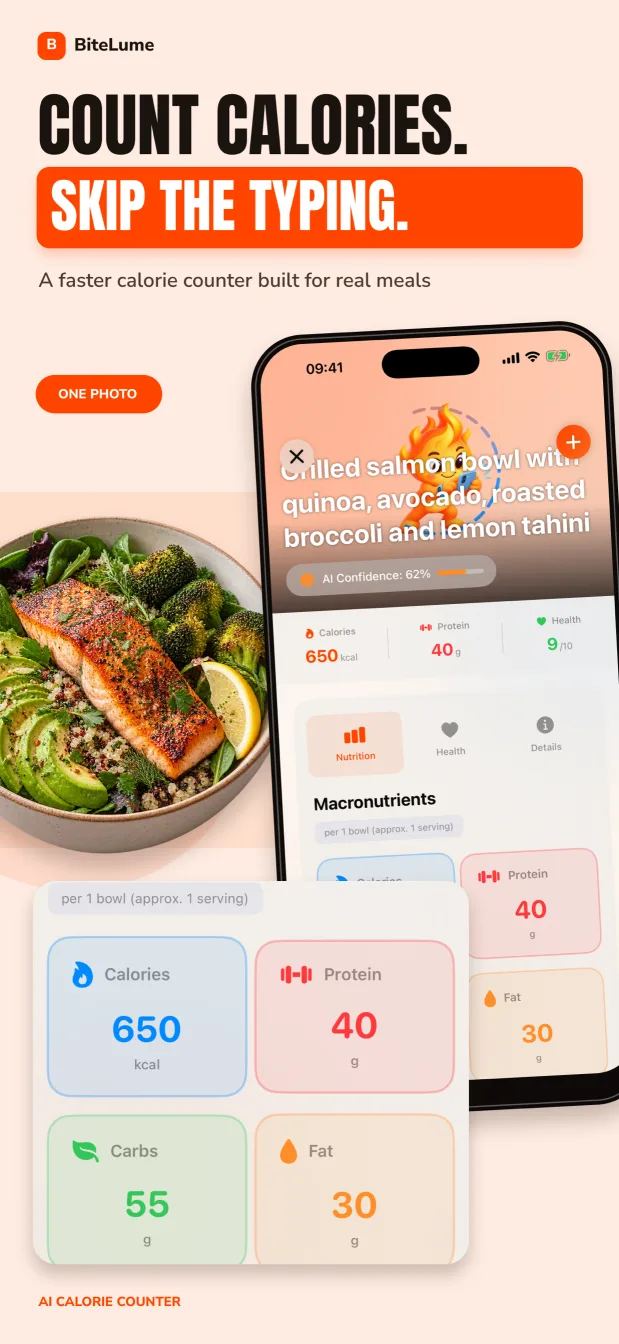
Take the meal photo in BiteLume and review the estimated calories alongside the known label. If your label only gives kJ, convert the matching portion to kcal before comparing the numbers. Do not interpret the roughly fourfold unit difference as proof that the app identified a different amount of food.
A unit conversion is exact arithmetic under the stated convention; the meal's portion and recipe can still be uncertain. Keep the converted label value beside your review and use it for a like-for-like comparison in kcal.
Questions people also ask
Are kcal the same as calories on food labels?
In ordinary nutrition use, a food Calorie refers to one kilocalorie, written kcal. This is different from the smaller scientific calorie unit.
How do I convert kilojoules to calories?
For food kilocalories, divide the kJ value by 4.184 using the thermochemical conversion. Keep the serving basis the same and round the final result sensibly.
Should I add kJ and kcal together?
No. When printed for the same portion, they express the same food energy in two different units.
Why does a label's kJ conversion not exactly match its kcal figure?
Displayed values may be rounded separately. Compare the same portion and avoid treating small rounding differences as additional energy.
Keep energy units connected to the meal.
Review a BiteLume photo estimate alongside the calories for the portion stated on your label.