Use grams with a gram-based nutrition reference and milliliters with a volume-based reference. Convert only with a reliable food-specific density or a product serving that states both weight and volume. A scale's mL mode typically converts mass using an assumption; it does not directly measure the volume of milk, oil or syrup.
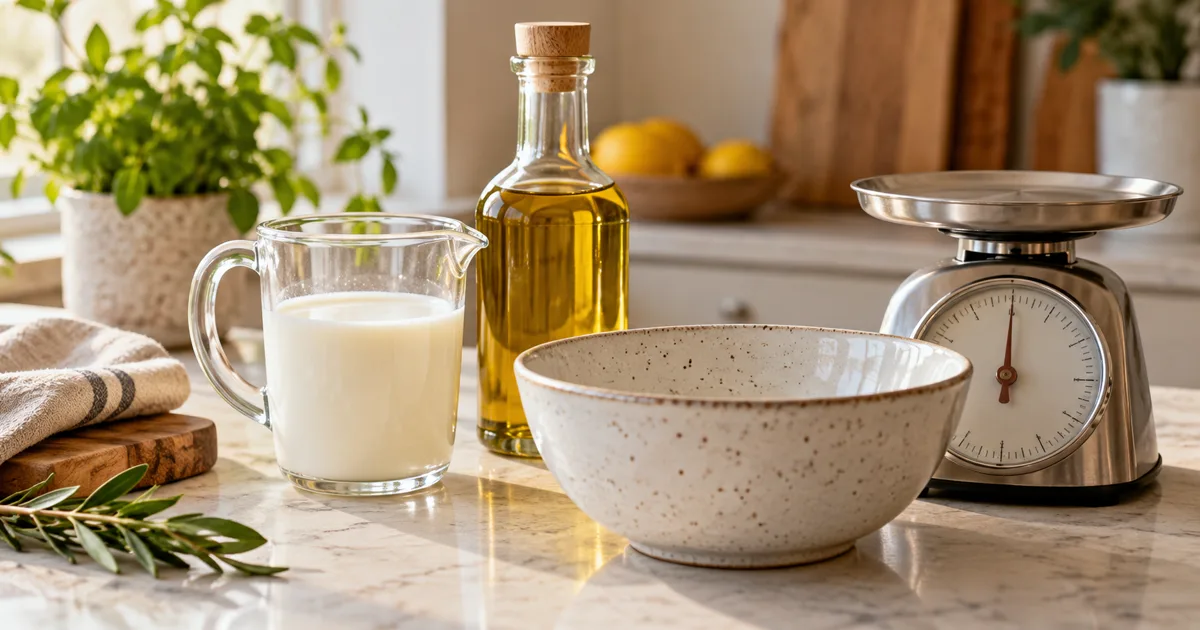
The unit mismatch happens before the calorie calculation
Grams describe mass; milliliters describe volume. Two liquids can fill the same measuring cup while weighing different amounts. The calorie calculation is only as useful as the match between your measurement and the label's stated amount.
An Australian or New Zealand nutrition panel commonly shows values per serving and per 100 grams or 100 milliliters. Other markets also use weight or volume serving references. Read the actual panel instead of assuming a liquid must always be logged in milliliters.
Sources for this section: FSANZ: nutrition information panels
What a scale's mL button can and cannot do
A normal kitchen scale senses mass even when its screen displays mL. The device converts the mass using its programmed assumption. For example, Salter's 1079 instructions describe the volume mode as suitable for water-based liquids. Check the manual for your model rather than assuming the setting is calibrated for every liquid.
For a food reference expressed per 100 grams, there is usually no reason to switch to mL mode at all. Keep the scale in grams, tare the container and weigh the food. If the package uses milliliters only, measure volume or obtain a reliable conversion for that product.
Sources for this section: Salter 1079: volume-mode instructions (PDF)
The easiest route is to keep both sides in the same unit
Suppose a hypothetical milk label lists 60 kcal per 100 mL and you measure 250 mL in a jug. The calculation is 250 ÷ 100 × 60 = 150 kcal. The units already match, so there is no density step.
For a product whose label instead gives 80 kcal per 20 grams, a 15-gram portion gives 15 ÷ 20 × 80 = 60 kcal. These are arithmetic examples rather than generic nutrition values for milk or another food. Replace the inputs with the exact product reference.
Swipe to see the full table
| Measured quantity | Reference quantity | Next step |
|---|---|---|
| 250 mL | Per 100 mL | Scale directly by 2.5 |
| 15 g | Per 20 g | Scale directly by 0.75 |
| Measured grams | Per 100 mL | Find a product-specific conversion or measure volume |
| Measured mL | Per 100 g | Find a product-specific conversion or weigh it |
When a conversion is necessary, name the density
Density connects mass and volume: mass in grams equals volume in milliliters multiplied by density in grams per milliliter. To convert in the other direction, divide mass by density. A density figure belongs to a particular food and conditions, so it should not be borrowed indiscriminately.
For illustration, assume a liquid has a documented density of 0.90 g/mL. A 30 mL portion would weigh 27 grams. This example density is not a recommended conversion for every cooking oil. Use a product's dual-unit serving or a reliable food-specific source, and avoid more decimal places than the measurement warrants.
Sources for this section: FSANZ: converting ingredient volumes to gram weights
Milk, oil and sticky liquids have practical workarounds
For milk in a home coffee, you can measure the poured volume with a suitable jug when the label is volume-based. For oil with a gram-based reference, weighing the bottle before and after pouring can be easier than cleaning a measuring spoon. Keep the before-and-after unit the same.
For syrup or nut butter, residue left in a spoon can make a nominal serving misleading. Weighing the amount added directly to the bowl can help if the reference is gram-based. The goal is a clean relationship between the food added and the stated reference, not weighing every drop indefinitely.
Keep unit evidence beside the meal photo
BiteLume can give you a starting estimate for the photographed food and drink. When you know the product and amount, use that information to review the scan. A picture cannot reliably distinguish the exact milk type, oil quantity or syrup formulation.
If you add a drink separately, check that it was not already counted within the meal estimate. Keep the finished record in one unit system for each component. Clear quantities make repeated drinks easier to compare without turning a simple coffee into a daily conversion exercise.
Questions people also ask
Is 100 mL always the same as 100 grams?
No. The relationship depends on density. Water is a useful approximate reference, but other liquids and foods need their own conversion.
Can a kitchen scale measure milliliters?
A typical scale measures mass and converts it using a programmed assumption. Check the model's instructions and use grams directly when the food reference is gram-based.
Should I weigh cooking oil in grams or milliliters?
Match the label or reference. Grams work well with a gram-based value; for a volume-based value, measure volume or use a reliable product-specific conversion.
Can a photo tell me the exact amount of milk in coffee?
No. Cup size, ice, foam and the drink's recipe can obscure the amount. A measured quantity or matching menu value is stronger evidence.
Turn a measured portion into a useful meal record.
Use BiteLume to capture the meal and review its estimate alongside matching label quantities.