No. Sugar-free food can still contain calories from other ingredients, including fat, starch, protein and some sweeteners. Check the Nutrition Facts panel for the portion you eat. Do not remove a snack from your food log because the front of the package says sugar-free, and do not subtract sweetener calories from a label that has already accounted for them.
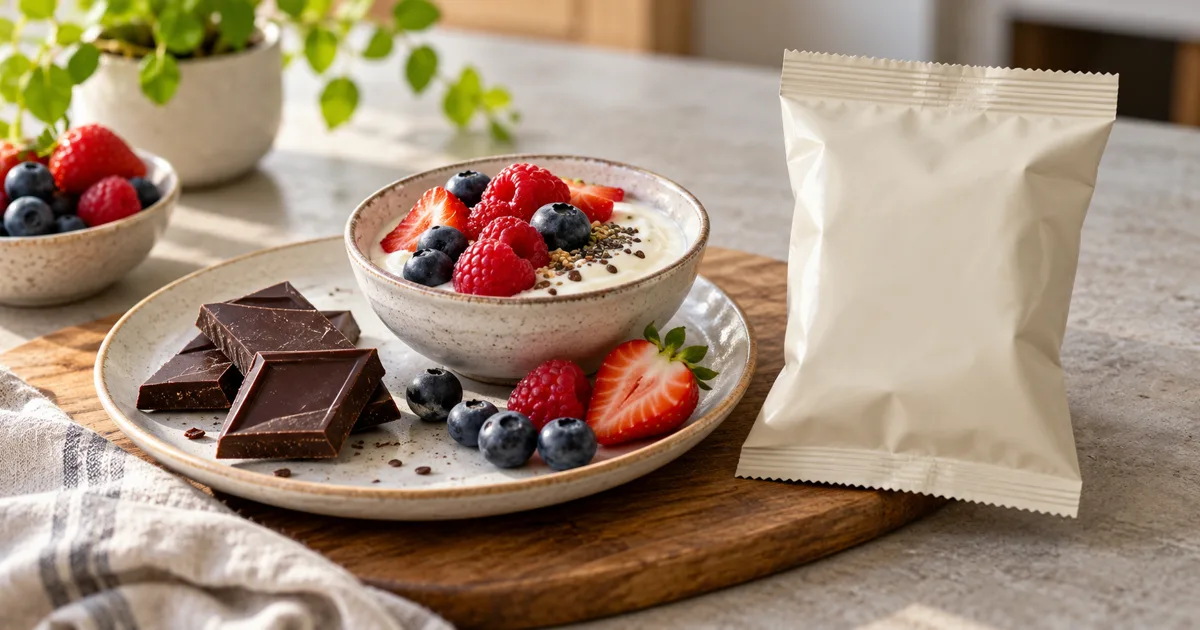
Read the calorie line as well as the sugar line
A reduced-sugar formulation does not tell you the whole product's energy. The manufacturer may use other ingredients for texture, bulk and flavor. The FDA's sugar-alcohol guide specifically notes that sugar-free products can still contain substantial calories, carbohydrate and fat.
Compare the portions before comparing the numbers. A smaller stated serving can make one snack appear lower in calories even when its per-gram value is similar. For your log, use the amount you actually eat rather than treating the printed serving as a personal recommendation.
Sources for this section: FDA: sugar alcohols and sugar-free products · FDA: how to understand and use the Nutrition Facts label
Sugar-free, no added sugar and calorie-free answer different questions
Sugar-free and no added sugar are not interchangeable ideas. A food made without added sugar can contain sugars naturally present in its ingredients. A calorie claim concerns energy rather than the source of sugar. The exact legal definitions and thresholds vary by jurisdiction, so this article does not apply one country's threshold to every package.
Check the product's local label rather than deciding from a slogan alone. If you need the U.S. regulatory wording, FDA rules distinguish sugar-content claims from calorie-content claims. Neither is a reason to ignore serving size or the rest of the nutrition panel.
Swipe to see the full table
| Wording | Question it addresses | What to check next |
|---|---|---|
| Sugar-free | The product's sugar claim | Calories, serving size and ingredients |
| No added sugar | Whether qualifying sugars were added | Naturally present sugar and total calories |
| Reduced sugar | A comparison with a reference product | The actual comparison and equal portions |
| Calorie-free | A regulated energy claim | Local rules and the stated amount |
Sources for this section: eCFR: U.S. sugar-content claims, 21 CFR 101.60
Different sweeteners do different jobs in a recipe
High-intensity sweeteners can provide sweetness in small amounts. Sugar alcohols can also contribute bulk and texture and generally provide fewer calories per gram than sugar, with differences among compounds. They are not the same as beverage alcohol. The ingredient list helps identify what a product uses.
These differences help explain why the sugar line alone cannot reconstruct the calorie line. Use the declared energy as your starting point instead of subtracting all sugar-alcohol grams at a universal rate. A package has already used a permitted calculation method for its own declared value.
Sources for this section: FDA: sweeteners in food
A worked snack comparison
Imagine two hypothetical snack labels. Product A lists 160 kcal per 40 grams; product B lists 120 kcal per 30 grams. Both equal 4 kcal per gram in this example, so the smaller displayed calorie number does not indicate a lower energy density.
If you eat 45 grams of either example product, the calculation is 45 × 4 = 180 kcal. These are illustrative label values, not an analysis of a real brand. The method is to align quantities first, then compare or log the actual portion.
- Find calories and the associated serving amount.
- Check how much of the package you ate.
- Scale the calorie value to that amount.
- Do not subtract sugar or sweeteners again from the declared calories.
- Add any toppings or drinks that are outside the product reference.
A tracking decision is not a verdict on the food
A sugar-free option may suit someone's preference or circumstances, but one claim does not establish that it is automatically healthier, better for weight management or appropriate for a medical condition. Read the whole product in the context of the meal.
Some sweeteners can cause digestive symptoms for some people. That is a reason to notice your experience and seek appropriate advice when needed, not a reason for this calorie-tracking article to prescribe a treatment or a restriction. Keep medical decisions separate from an app estimate.
Review the snack photo against its label
Photograph the snack in BiteLume while you still have the wrapper and portion information. Review the identified food and calories against the exact product label. A photo cannot reliably reveal which sweetener was used in a chocolate or dessert.
The useful routine is short: capture the food, check the serving, compare the label, and keep the result with the rest of the eating occasion. The front-of-pack claim remains context rather than a shortcut that makes the food disappear from the log.
Questions people also ask
Does sugar-free food have zero calories?
Not necessarily. Other ingredients and some sweeteners can supply energy. Use the calorie line for the amount you eat.
Is no added sugar the same as sugar-free?
No. Foods without added sugar may contain naturally present sugars. Exact claim requirements depend on local labeling rules.
Should I subtract sugar alcohols from label calories?
Do not automatically subtract them again. The declared calorie value already reflects the product's calculation method; a universal subtraction can double-correct the number.
Can BiteLume identify sugar-free food from appearance?
Appearance cannot reliably establish the formulation. Use the exact label or known recipe when reviewing the photo-derived estimate.
Review the snack beyond its wrapper.
Photograph your portion in BiteLume and compare the estimate with the actual product label.