Use the formula calories ÷ grams = calories per gram. A 300-calorie food weighing 300 grams has a calorie density of 1 kcal/g; a 300-calorie food weighing 75 grams has 4 kcal/g. The two portions provide the same estimated energy but very different physical amounts. Calorie density is descriptive—not a score of whether a food is healthy, filling or appropriate for you.
What calorie density means
Calorie density connects energy with weight. Researchers commonly express it as kilocalories per gram of food. A lower number means fewer calories are contained in each gram; a higher number means more energy is concentrated into the same weight. The concept can be applied to one ingredient, a cooked recipe, a plated meal or an overall food pattern when the necessary weights and calories are known.
The arithmetic is simple: divide total calories by total edible grams. If a prepared dish contains an estimated 900 calories and weighs 600 grams, its average density is 1.5 kcal/g. A 250-gram serving from the same evenly mixed batch would be estimated at 375 calories: 1.5 multiplied by 250.
The quality of the result depends on the inputs. Missing oil changes calories, an incorrect cooked weight changes the denominator, and an uneven casserole may not distribute ingredients perfectly. Calorie density can make the method transparent without turning an ordinary home recipe into a laboratory measurement.
Swipe to see the full table
| Example | Estimated calories | Weight | Calculated density |
|---|---|---|---|
| Water-rich bowl | 300 kcal | 500 g | 0.6 kcal/g |
| Mixed cooked meal | 600 kcal | 400 g | 1.5 kcal/g |
| Dry snack portion | 300 kcal | 75 g | 4.0 kcal/g |
| Cooking oil | 126 kcal | About 14 g | About 9.0 kcal/g |
Related: See how portion size changes a photo calorie estimate
Water and fat have the biggest visible effects
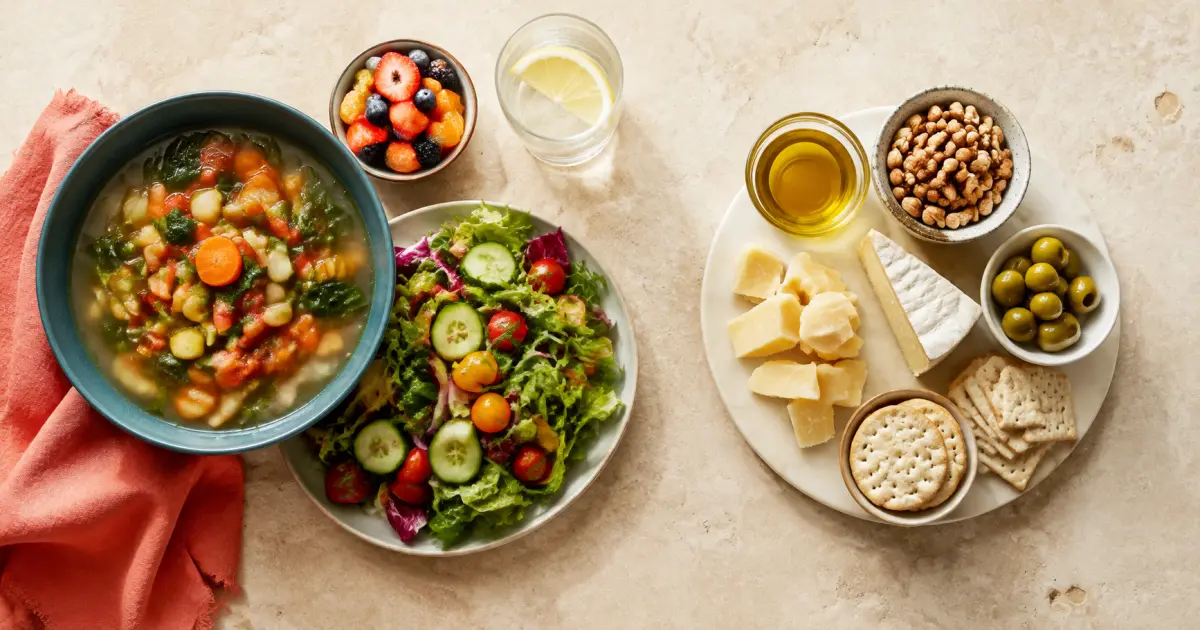
Water contributes weight and volume but no calories. That is why vegetables, fruit and broth-based dishes often occupy more space for a given calorie amount than dry foods. Cooking can move the number in either direction: boiling grains adds water and increases finished weight, while baking or roasting can remove water and concentrate energy per cooked gram.
Fat is energy-dense at about nine calories per gram, compared with about four for protein and carbohydrate. A modest amount of oil, butter, cheese, nuts or creamy dressing can raise a dish's average density without making the serving look dramatically larger. Those foods can also contribute flavor and nutrients; the point is to account for them, not to treat density as a moral label.
Fiber can accompany water-rich foods and contributes differently to available energy than fully digestible carbohydrate. Recipe structure matters too. Soup made with vegetables and broth has more water than the same ingredients concentrated into a sauce, while dried fruit contains less water than fresh fruit. Comparing the actual food state prevents misleading conclusions.
Calorie density describes energy per gram. Portion size describes how many grams you eat. Total calories depend on both: density × portion weight.
Separate calorie density from portion size
A low-density food can still contribute substantial calories when the portion is very large, and a high-density food can fit in a modest amount. Total meal calories are the product of density and portion. Focusing on only one side of that equation creates avoidable surprises.
Consider two servings of the same trail mix. Because the recipe is unchanged, both have roughly the same calories per gram. The larger handful still has more total calories. Now compare a bowl of broth-based vegetable soup with a small serving of crackers. Their weights can differ greatly, yet their calorie totals may be similar because the dry food packs more energy into each gram.
This distinction also explains why a camera struggles with some estimates. A photo can show surface area and provide scale clues, but depth, weight and hidden fat remain uncertain. Two bowls that fill the same outline can contain foods with different water content, ingredients and density. The portion guide covers the visual problem; calorie density explains the underlying food property.
Swipe to see the full table
| What changes? | Density | Portion | Likely effect on total calories |
|---|---|---|---|
| Same food, larger serving | Similar | Higher | Higher |
| More water added to a recipe | Lower | May look larger | Batch calories stay similar if nothing caloric is added |
| Oil added to a recipe | Higher | Slightly higher | Higher |
| Water lost during cooking | Higher per cooked gram | Finished weight lower | Whole-batch calories stay broadly similar unless fat or food is lost |
Calorie density is not nutrient density
The similar names describe different ideas. Calorie density is energy per unit of weight. Nutrient density considers beneficial nutrients relative to calories or another reference amount. A food can be calorie-dense and still contribute protein, unsaturated fat, vitamins or minerals. Nuts and seeds are familiar examples: small portions contain substantial energy and a range of nutrients.
The reverse is also important. A low-calorie item is not automatically a complete meal. Plain broth or a plate of low-starch vegetables may be low in calorie density, but an individual's meal may still need adequate energy, protein, fats and carbohydrate. Context includes the rest of the day, personal needs, culture, availability and enjoyment.
Use calorie density to explain how physical amount and energy relate, not to sort foods into virtuous and forbidden categories. A practical meal can combine water-rich foods with smaller amounts of energy-dense ingredients. The relevant question is whether the mix supports the meal you want, not whether every component has the lowest possible number.
Calculate calorie density for a home recipe
For a repeatable home calculation, add the calories for every ingredient used, including cooking fats, sauces and toppings mixed into the batch. If rendered fat, cooking liquid or another edible part is discarded, adjust the total when it can be measured; otherwise note that the calculation may be an overestimate. After cooking, weigh the edible finished recipe in grams. Divide the adjusted estimated calories by the finished weight. That gives an average calories-per-gram value for the batch.
Suppose a pot of chili contains an estimated 2,400 calories after all ingredients are counted and weighs 1,800 grams when finished. The average is about 1.33 kcal/g. A 350-gram bowl is therefore about 466 calories before separate toppings. If cheese or sour cream is added to only one serving, log it separately instead of spreading it across the whole batch.
Recalculate when the recipe or finished yield changes meaningfully. Using more oil raises the numerator. Simmering longer can reduce the finished water weight and raise calories per cooked gram even when whole-pot calories are similar. Saving both ingredient assumptions and finished weight makes future portions easier to explain.
- Count every calorie-containing ingredient in the batch.
- Weigh the finished edible recipe, not the pot or discarded parts.
- Divide batch calories by finished grams.
- Multiply that value by the grams in your serving.
- Keep one-off toppings and sides outside the base recipe.
Use density to ask better questions about meals
You do not need to calculate kcal/g for everything you eat. The concept is most useful when two portions surprise you or when a repeat recipe keeps changing. Ask whether water content, cooking fat, drying, sauces or portion weight explains the difference. Those questions are more actionable than assuming a large-looking plate must be high in calories or a small snack must be low.
For packaged foods, calories per 100 grams can support a like-for-like comparison when the labels use that format. In the United States, the declared serving and gram weight provide enough information to calculate an approximate density. Still compare foods that serve a similar purpose; yogurt and olive oil are not alternatives simply because their numbers per gram differ.
If you want to change a meal's density while keeping its identity, test one adjustment at a time: add a water-rich component, change the amount of cooking fat, alter the sauce-to-solid ratio or revise the portion. Record the result and decide whether the taste, satisfaction and practicality still work. No calculation can answer those questions for you.
Use BiteLume to connect density with the visible portion
Take a photo of the full serving in BiteLume before eating, with the plate or bowl edge visible. Review each identified component and its estimated portion. Pay particular attention to oil, dressing, cheese, nuts, sauces and beverages, because a small-looking amount can affect the energy estimate. Compare the result with anything you know from the recipe or label.
A meal photo cannot measure calories per gram on its own. BiteLume's calorie and macro values are estimates based on the foods and portions it can infer. When you have a known batch total and cooked weight, use that stronger recipe calculation for the serving and keep the photo as the visual record. When you do not, use the scan as a starting point and retain reasonable uncertainty.
Over time, compare repeat meals prepared in similar ways. A photo history may show that one pasta plate includes a creamy sauce while another uses a tomato-based sauce, or that the same bowl is filled to different depths. Density gives you language for why the estimates differ; the images help you trace the ingredients and portions behind the number.
Questions people also ask
What is calorie density?
Calorie density, or energy density, is the number of calories in a given weight of food. It is commonly expressed as kilocalories per gram.
How do I calculate calorie density?
Divide the food's total calories by its edible weight in grams. A 500-calorie dish weighing 400 grams has an average density of 1.25 kcal/g.
Is low calorie density always healthier?
No. Density describes energy per gram, not overall nutrition or suitability. Foods with higher density can contribute valuable nutrients, and low-density foods may not form a complete meal alone.
Can a photo calculate exact calorie density?
No. A photo does not directly measure food weight, recipe composition or hidden ingredients. It can support a reviewed estimate, while a known recipe and finished weight provide stronger inputs.
Make the next meal easier to track.
Use a photo to get a calorie and macro starting point, review the details, and keep your progress in one place.